Why Glossier Is Worth Studying Right Now
Glossier is a US direct-to-consumer beauty brand that started life as a blog — Emily Weiss's Into The Gloss — and turned a reader community into a cult brand spanning skincare, makeup, and fragrance. This analysis uses Thea Care's Brand Performance Framework to score Glossier across visibility, positioning, e-commerce, portfolio, and tech sophistication, and to draw out the one thing it does better than almost anyone: turning customers into a community that markets the brand for free.
I have spent the last few years looking at how skincare brands earn demand. Most buy it — paid social, search, influencer fees. A few engineer it through a sharp product story. Glossier did something rarer: it built an audience first and a product line second, so that by the time it sold anything, it already had people who felt like owners. That is a different kind of moat from the ones I have written about in this series, and it is the reason a brand manager should study Glossier even though, strictly speaking, skincare is only one shelf of what it sells.
How We Scored Glossier (And Why It Matters)
For this analysis we used Thea Care's proprietary Brand Performance Framework, the same system we apply across our Brand Analysis Index. It evaluates digital-first beauty and skincare brands across five dimensions:
- Brand Visibility Score
- E-commerce Performance Score
- Product Portfolio Quality Score
- Brand Positioning Score
- Tech Sophistication Score
Each score runs from 0 to 100 and blends quantitative data (traffic, engagement, performance diagnostics) with qualitative UX assessments. On top of that we add a UX Quality Score and channel-specific diagnostics like Mobile Score and Desktop Score.
For Glossier:
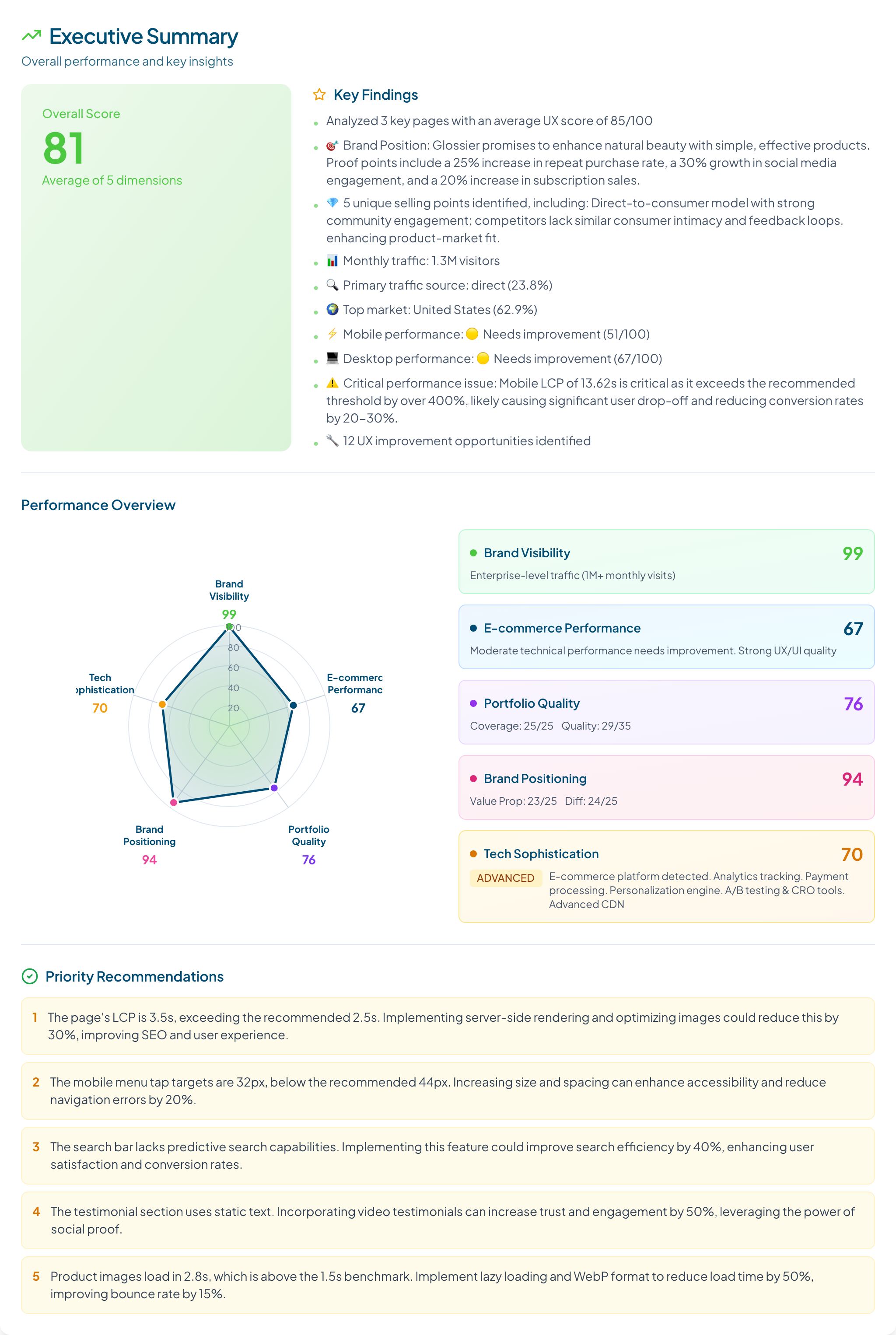
- Overall Score: 81 / 100
- Brand Visibility: 99 / 100
- Brand Positioning: 94 / 100
- Product Portfolio Quality: 76 / 100
- E-commerce Performance: 67 / 100
- Tech Sophistication: 70 / 100
- UX Quality: 85 / 100
- Mobile Performance: 51 / 100
- Desktop Performance: 67 / 100
In other words, Glossier has built one of the most visible, best-positioned brands we have scored — and it sits on a more capable tech stack than most of the series. Where it leaves money on the table is in the conversion layer: turning that enormous, loyal audience into more purchases per visit.
Brand Overview: Glossier At A Glance
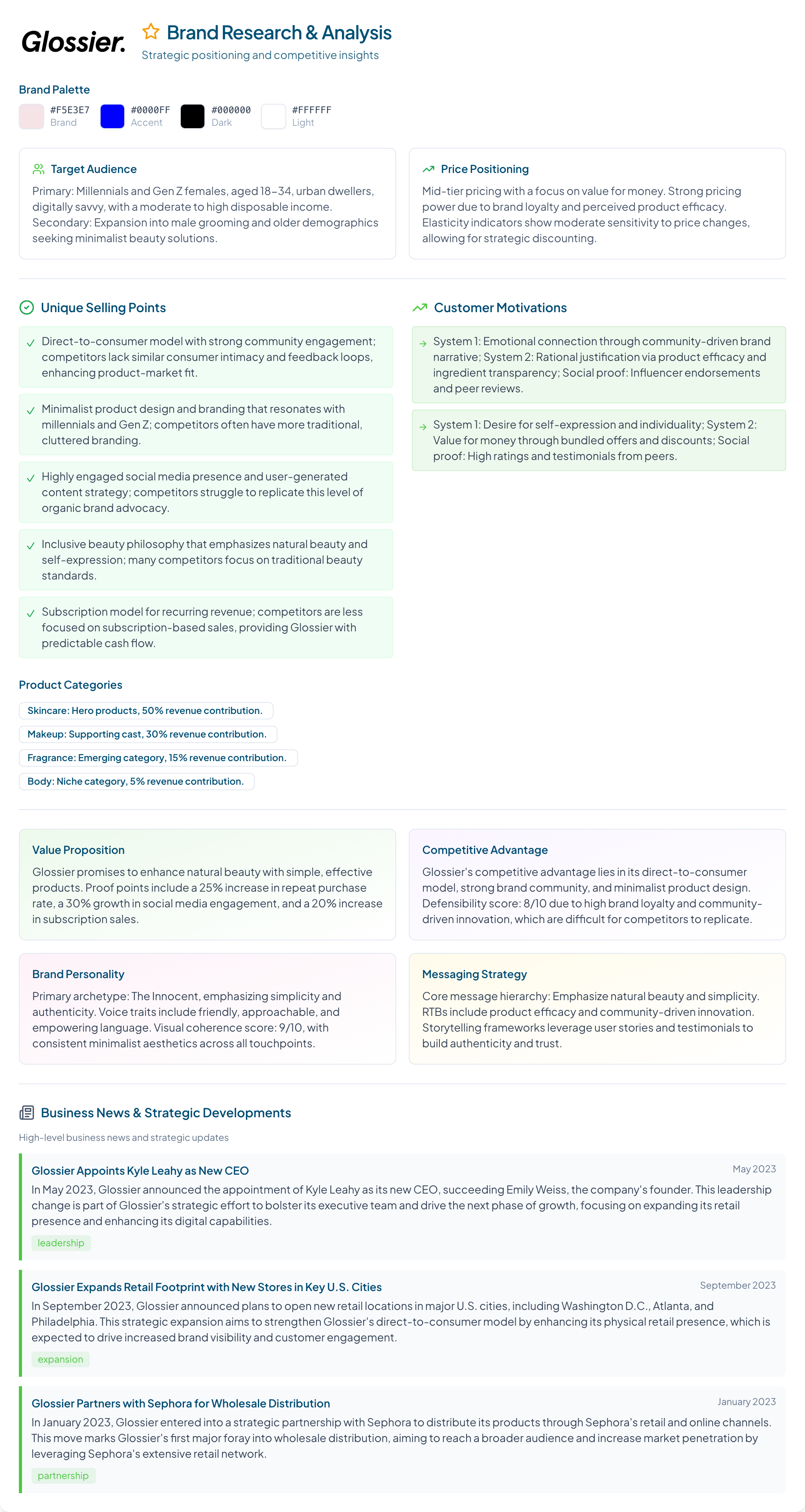
Glossier was founded by Emily Weiss as an extension of Into The Gloss, a beauty blog built on interviewing real people about real routines. That origin is the whole story: the brand started as a conversation and only later sold products into it. The promise is consistently "skin first, makeup second" — enhance what is already there with simple, multi-use products, in minimalist packaging that has become its own visual language.
The value proposition comes through cleanly:
- A direct-to-consumer model built on genuine community engagement and feedback loops
- Minimalist product design and branding that reads instantly as "Glossier"
- An inclusive, "real beauty" philosophy rather than aspirational perfection
- Heavy reliance on user-generated content and organic advocacy over paid media
- A subscription/replenishment angle for recurring revenue
The brand's archetype, in our analysis, is The Innocent: friendly, approachable, empowering — a visual coherence score of 9 out of 10 across every touchpoint. The audience is exactly who you would expect: millennials and Gen Z, roughly 18 to 34, urban, digitally native, with a secondary push into male grooming and older minimalist-beauty shoppers.
Where Glossier is genuinely defensible is its community. Our analysis puts its competitive moat at 8 out of 10, and the reason is specific: community-driven innovation and brand loyalty that competitors cannot buy. This audience overlaps with the skintellectual shopper but skews more emotional than analytical — people buy Glossier to belong, not only to optimize a routine.
Insight 1: A Community Moat, Not a Marketing Budget
Glossier scores 99 out of 100 on Brand Visibility, and the way it earns that score is the single most important lesson in this analysis. It pulls around 1.3 million monthly visits — but look at the channel mix: roughly 24 percent of traffic is direct, far higher than the branded-search-led pattern most DTC brands run on. People are not googling Glossier and clicking an ad. They are typing it in because they already belong to it.
This is the inverse of how most of the brands in this series earn demand. Rhode engineered a distributed creator engine around a celebrity founder; Typology earns search traffic with radical transparency content. Glossier earns it through identity. The brand started as a blog, so its first asset was an audience, and every product since has been launched into a community that treats the brand as partly theirs. User-generated content, not paid placement, does the heavy lifting.
That distinction matters because a community moat behaves differently from a content or celebrity moat. It is slower to build, but far harder for a competitor to copy — you cannot buy belonging the way you can buy reach.
How to apply this insight
If you lead marketing for a 50 to 250 person skincare brand, the takeaway is not "post more UGC." It is:
- Decide whether you are building an audience or just a funnel. An audience is something people return to directly; a funnel is something you keep repurchasing traffic into.
- Give your most engaged customers a real role — early access, feedback that visibly shapes products, a name for the community. Glossier's edge is that customers feel like owners.
- Measure direct and returning traffic as a first-class metric, not just paid ROAS. A rising direct share is the clearest signal that a community is forming.
Insight 2: Positioning So Coherent It Reads as Identity
A lot of beauty brands chase whatever aesthetic is trending. Glossier does the opposite, and it shows: 94 out of 100 on Brand Positioning — one of the highest scores in this series. Value-proposition clarity, visual consistency, and differentiation are all strong, and the proof points are concrete: a reported 25 percent lift in repeat purchase rate and 30 percent growth in social engagement tied directly to that consistency.
The positioning works because it is narrow and absolute. "Skin first, makeup second," minimalist millennial-pink design, real people over retouched models — repeated so consistently that the look became shorthand for a whole category. A shopper can identify a Glossier product, ad, or store from across a room.
Here is the part worth sitting with, and where Glossier contrasts sharply with a sibling in this series. Augustinus Bader's moat is its science — proprietary TFC8® technology that is genuinely hard to replicate. Glossier's moat is the opposite kind: not a defensible ingredient but a defensible feeling. That is powerful, and it is also fragile — an identity-led brand has to keep earning the identity, because the moment the community stops feeling ownership, the moat thins. Both are real moats; they just demand completely different playbooks.
How to apply this insight
- Pick a position narrow enough to own and repeat it past the point of boredom. Glossier's consistency is a feature, not a limitation.
- Know which kind of moat you have. Science and IP are defended with proof; community and identity are defended with consistency and participation. Confusing the two is how brands over-invest in the wrong thing.
- Audit whether someone could identify your brand with the logo removed. If not, your positioning is decoration, not identity.
Insight 3: Landing Pages That Look Right — On a Sale-Heavy Storefront
Glossier's UX design scores 85 out of 100 across the pages we analyzed. The layouts are clean, the journeys are simple, and the brand's minimalist visual language carries through from homepage to product page. (At the time of capture the storefront was running a sitewide "Friends of Glossier" sale, so promotional styling is visible throughout — worth noting so you read the screenshots correctly.)
Homepage
The homepage does the fundamentals well: a clear visual hierarchy, strong brand imagery, and a reading path that guides the eye. The softer spots are the same ones that quietly tax most beauty storefronts — trust and wayfinding details that could be hardened, and a heavy promotional layer that, during a sale, can crowd out the product story.
Collections Page
The skincare collection page is clean and on-brand: a two-column mobile grid, product cards with clear pricing, and quick add-to-bag. Discovery is decent but not intelligent — there is no guided selling or concern-based routing that would help a shopper who knows their problem ("dull skin," "barrier repair") but not the product. For a brand whose whole promise is simplicity, that is the most natural place to go next.
Product Detail Page
The PDP carries the brand's storytelling strength — benefits over features, lifestyle imagery, social proof. Where it can evolve is the same theme: turning that strong narrative into a guided next step rather than leaving the shopper to self-navigate the catalog.
One word on speed, because it is easy to over-index on it. Glossier's lab page-speed scores sit in the "needs improvement" band (mobile 51, desktop 67). That is worth a line in your next dev briefing, but lab scores are synthetic and volatile, and a brand with this much direct, loyal traffic is not losing its audience over it. Treat it as routine maintenance, not the headline. Measuring page-level tweaks against AOV and conversion is what tells you whether it is actually costing you.
Insight 4: The Conversion Gap — A Loyal Audience That Could Buy More Per Visit
Here is where the money is, and it is a different gap from the ones earlier in this series. Glossier does not have a demand problem or a positioning problem. It has a depth-of-visit problem: an average session is around 1 minute 37 seconds with roughly 3.3 pages per visit. That is an engaged audience moving fast — and a brand with this much loyalty should be converting more of those visits into larger baskets.
The lever is personalization and guided selling. Right now, a shopper who arrives knowing they belong to Glossier still has to figure out which products fit their skin on their own. There is no diagnostic, no routine builder, no "if you love Milky Jelly, here is your full routine" path. For a brand whose customers already trust it deeply, that is a remarkable amount of intent left on the table.
This is exactly where AI-powered personalization earns its place. A 30 to 60 second AI skin analysis can turn a fast, loyal visit into a guided routine — "here is your barrier-repair set," "here is your first-retinol routine" — built on consistent, reliable skin profiles rather than guesswork. For a brand that already has the hardest thing (a community that wants to buy), the upside is converting that trust into a bigger, more personalized basket.
How to apply this insight
Audit your own depth-of-visit before you spend on more traffic. If your engaged, returning shoppers move fast and buy one thing, the opportunity is not more visits — it is helping each visit go deeper. Guided selling and personalization are how loyal audiences turn into larger baskets, and they pay off most for the brands that already have the audience.
Insight 5: A Broad Catalog Where Skincare Is the Anchor, Not the Whole Store
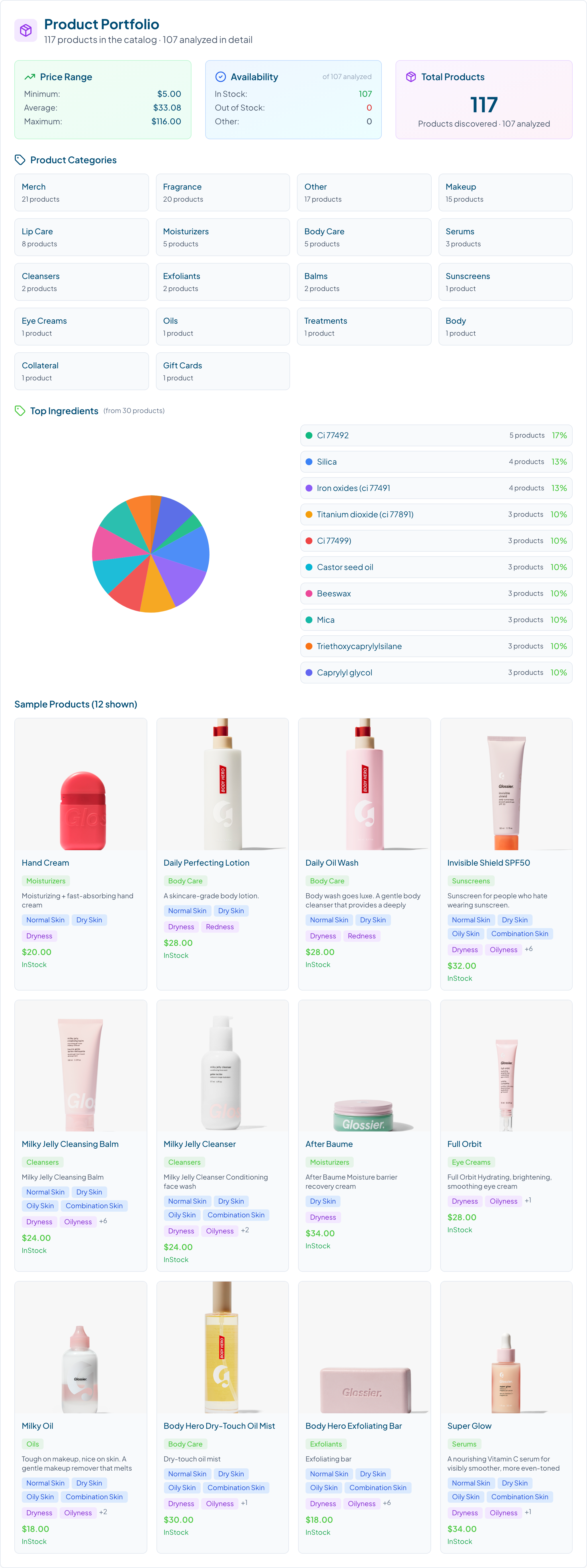
Glossier's Product Portfolio Quality Score sits at 76 out of 100. The important thing to understand — and the reason this analysis reads the catalog the way it does — is that Glossier is a beauty brand, not a skincare-pure one. Makeup, fragrance, and even merch sit alongside the skincare line. We lead the portfolio view with skincare because that is the lens of this series, but it is worth being honest that skincare is one pillar of a broader empire.
From the data:
- Total products: 117
- Average price: around $33
- Price range: roughly $5 to $116, from single balms up to sets
- Skincare core: cleansers (Milky Jelly), moisturizers (Priming Moisturizer, After Baume), serums (Super Bounce, Super Pure, Super Glow), an SPF (Invisible Shield), eye and exfoliant products — anchored by genuine hero SKUs
The skincare line is the brand's foundation and its most credible territory — the "skin first" promise is literal. The makeup and fragrance extensions ride on the trust the skincare built. For a skincare team, that is the lesson: a coherent, hero-led skincare range is what earns the right to extend into adjacent categories. Glossier did not start broad; it started with skin and expanded once the community trusted it there.
Where personalization changes the game
A focused skincare core inside a broader catalog is, if anything, the ideal setup for AI-driven personalization, because it lets you route a shopper to the right skincare routine first and then extend naturally into the makeup and fragrance they are already inclined to trust. The technology does the curation in the background; what the shopper sees is a routine that feels designed for them. See also: AOV uplift from AI personalization.
Key Takeaways For Skincare Brand Teams
If you are leading growth, digital, or product at a skincare brand, Glossier's analysis highlights five lessons that a transparency- or science-led brand cannot teach you, ordered roughly by effort:
The throughline: where Typology must fix discovery and Bader defends its science, Glossier's job is to convert a community it already owns. Different moat, different playbook. See also the 2026 differentiation playbook.
Where AI-Powered Personalization Fits In
When we built Thea Care's analysis tooling, one pattern showed up again and again. The brands that win over the next five years are rarely the ones with the most products or the biggest budgets. They are the ones that understand their audience at a granular level, translate that understanding into smart digital journeys, and use AI to scale the kind of advice that used to only happen at a beauty counter.
Glossier has already done the hardest part — it owns a community most brands would trade their paid budget for. The room for growth is in the layers that convert that trust:
- An AI-powered skin analysis that feels like a one-to-one consultation
- Product recommendations that turn a fast, loyal visit into a complete routine
- Personalization that respects both skin profile and the brand's "keep it simple" promise
That is exactly the gap Thea Care exists to fill for brands like Glossier and for the next generation of digital-first beauty leaders.
Frequently Asked Questions
What makes Glossier's brand strategy different?
Glossier is a community-led brand: it began as the beauty blog Into The Gloss and built an audience before it built products. Its moat is identity and community loyalty (a defensibility score of 8 out of 10 in our framework) rather than a proprietary ingredient or a celebrity founder. Roughly 24 percent of its traffic is direct, which signals an audience that returns on its own rather than being repurchased through ads.
How does Glossier score on the Brand Performance Framework?
Glossier scores 81 out of 100 overall: Brand Visibility 99, Brand Positioning 94, Product Portfolio Quality 76, E-commerce Performance 67, and Tech Sophistication 70, with a UX Quality score of 85. Its strengths are visibility and positioning; its opportunity is converting a loyal audience into deeper, more personalized purchases.
Is Glossier a skincare brand?
Not strictly — Glossier is a broad beauty brand spanning skincare, makeup, and fragrance, with skincare as its founding pillar ("skin first, makeup second"). Its skincare line — Milky Jelly Cleanser, Super serums, Priming Moisturizer, Invisible Shield SPF — is the credible core that earned the brand the right to extend into adjacent categories. This analysis reads the catalog through that skincare lens.
What can other skincare brands learn from Glossier?
Three things: build an audience you own (measured by direct and returning traffic), not just a paid funnel; make your positioning consistent enough to be identifiable without the logo; and earn category extensions with a hero-led skincare core rather than launching broad. A loyal community is also the ideal foundation for AI-driven personalization, which converts trust into larger baskets.
Conclusion
Glossier is not perfect. It is successful in a very specific, hard-to-copy way.
On one side, you have a brand that turned a blog into a community and a community into a cult, with positioning so consistent it became a category shorthand. On the other, you have a fast, loyal audience that could buy more per visit — a conversion-depth gap, not a demand gap, and an almost complete absence of personalization on top of all that trust.
For Glossier, this is good news: the expensive part is done. For you, as a marketing or product leader, it offers a blueprint that the science- and transparency-led brands in this series cannot — build something people belong to, then use personalization and AI to turn that belonging into a deeper relationship and a bigger basket.
If you want to see how AI-powered skin analysis and personalization could increase your revenue and improve customer experience, let us talk.
In a 30 minute discovery call, we will:
- Map your current customer journey from first touch to repeat purchase
- Identify 2 to 3 high-impact personalization opportunities
- Walk through how Thea Care's AI layer can plug into your existing stack
No generic pitch. Just a focused conversation about what is realistically possible for your brand in the next 6 to 12 months.