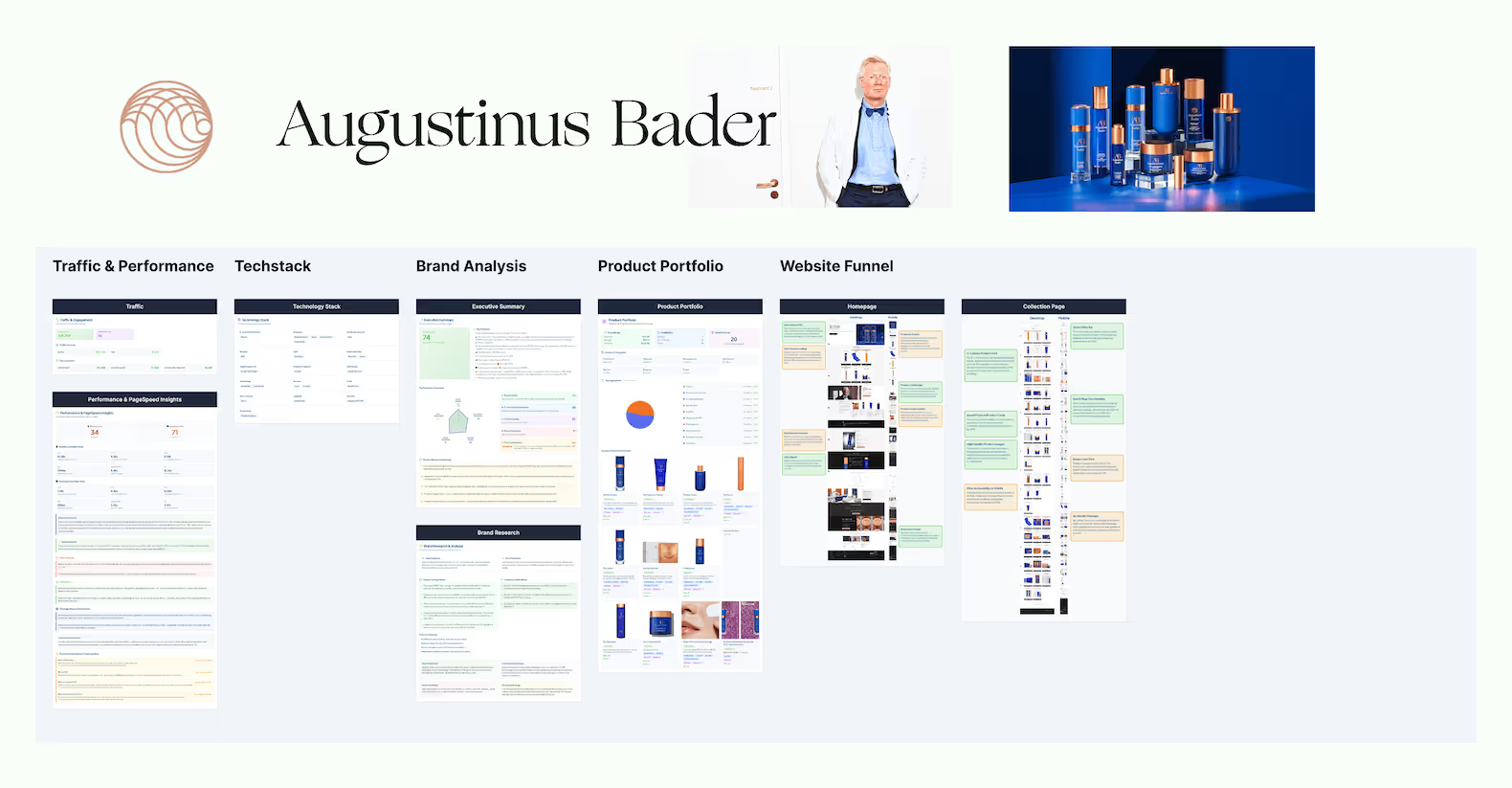
Augustinus Bader is a luxury skincare brand built on TFC8®, a proprietary regenerative-medicine complex, and a deliberately minimalist portfolio. This analysis breaks down how the brand’s science-first positioning, restrained product range, tiered loyalty, and Dua Lipa collaboration translate into a defensible moat — and where mobile performance is still leaving revenue on the table. Methodology and scoring framework are described below.
For this analysis, we used Thea Care’s proprietary Brand Performance Framework, a scoring system we developed to evaluate digital skincare brands across five critical dimensions: Brand Positioning, Product Portfolio Quality, Brand Visibility, Tech Sophistication, and E-commerce Performance. You can explore how other leading skincare brands perform using these same metrics in our Brand Analysis Index. Each metric is calculated on a 0-100 scale, weighing factors like UX patterns, technical signals, conversion pathways, and portfolio coherence to highlight strategic opportunities brands can act on quickly.
This article brings together our December 5, 2025 audit of augustinusbader.com and supporting brand signals to surface what AB gets right, where the digital experience holds it back, and how brand and marketing managers can apply the lessons without copying the brand’s price point or celebrity aura.
Brand Overview: Science-First Luxury With a Cult-Grade Hero Story
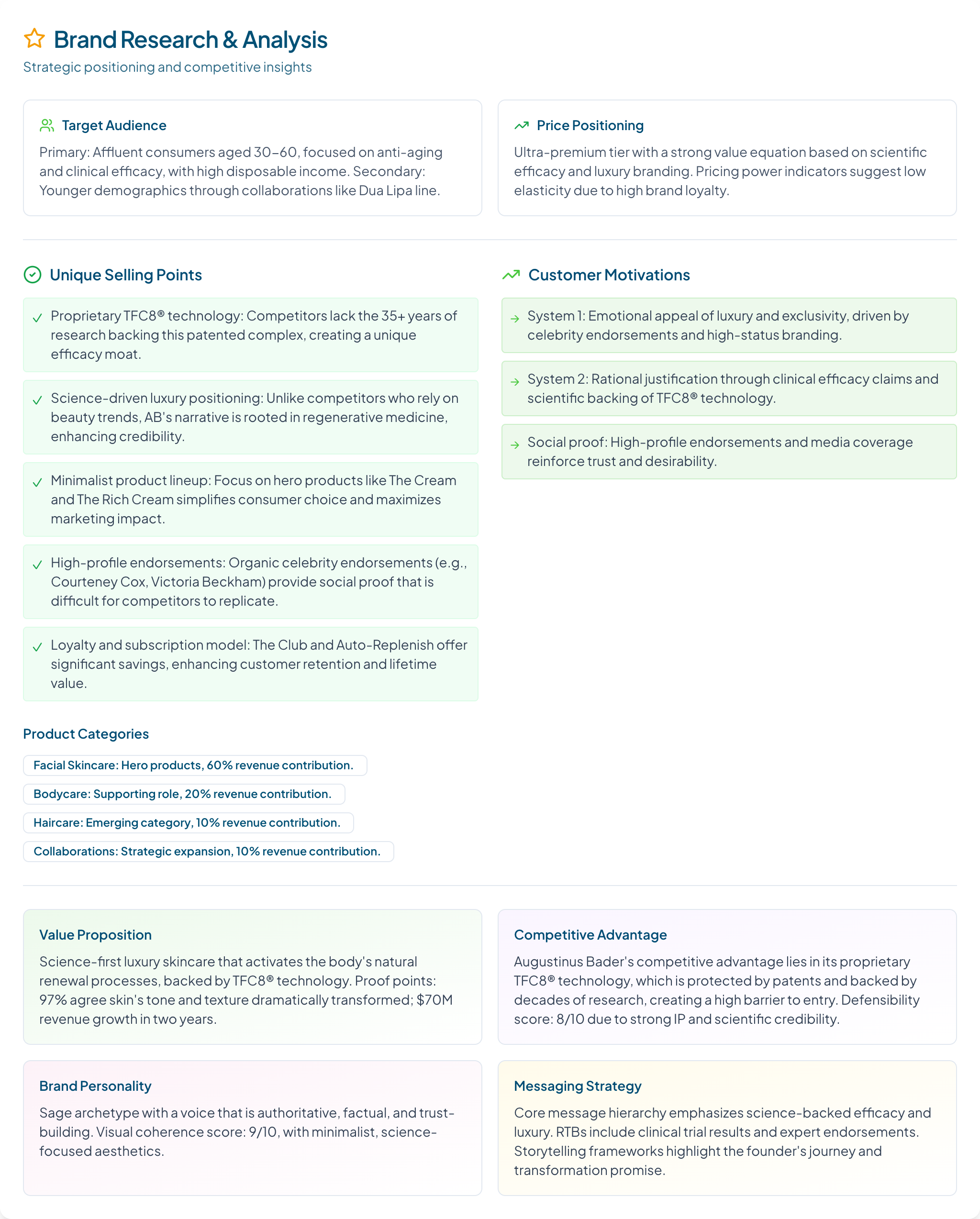
To understand Augustinus Bader’s modern advantage, you have to start with the brand’s foundational bet: credibility over cosmetics. AB sits squarely in science-first luxury skincare, anchored by its proprietary TFC8® technology and a narrative rooted in regenerative medicine. Our analysis reinforces that this positioning remains the brand’s most defensible moat, supported by strong IP and a consistent message across product architecture and content.
The brand’s value proposition, as our research suggests, is built on a simple promise: activate the body’s natural renewal processes using TFC8®, rather than layering trend ingredients. The report also cites a strong consumer belief signal, with analysis suggesting that 97% of customers agree skin tone and texture are dramatically transformed. Because this is scraped data, the exact number is best treated as directional rather than absolute. Still, the pattern is consistent with AB’s market reputation as a results-first luxury line.
AB’s primary target audience remains affluent consumers aged 30-60, motivated by anti-aging outcomes and high trust in clinical logic. The brand also appears to be strategically widening the aperture through collaborations designed to reach younger consumers. The standout signal here is the Dua Lipa collaboration, which aligns with a deliberate attempt to create a lower-price on-ramp and cultural relevance without redesigning the core brand.
From a brand manager’s perspective, that dual-audience strategy is the real story. AB is not abandoning the “bougie, dermal-spa” aura. It is creating controlled entry points that do not force the flagship line to compromise.
5 Strategic Deep-Dives
1. The TFC8® Moat Is a Brand Asset, Not Just an Ingredient
Why this matters:
In skincare, it is easy to confuse differentiation with novelty. AB shows that the most powerful differentiation is often the one you can defend for a decade.
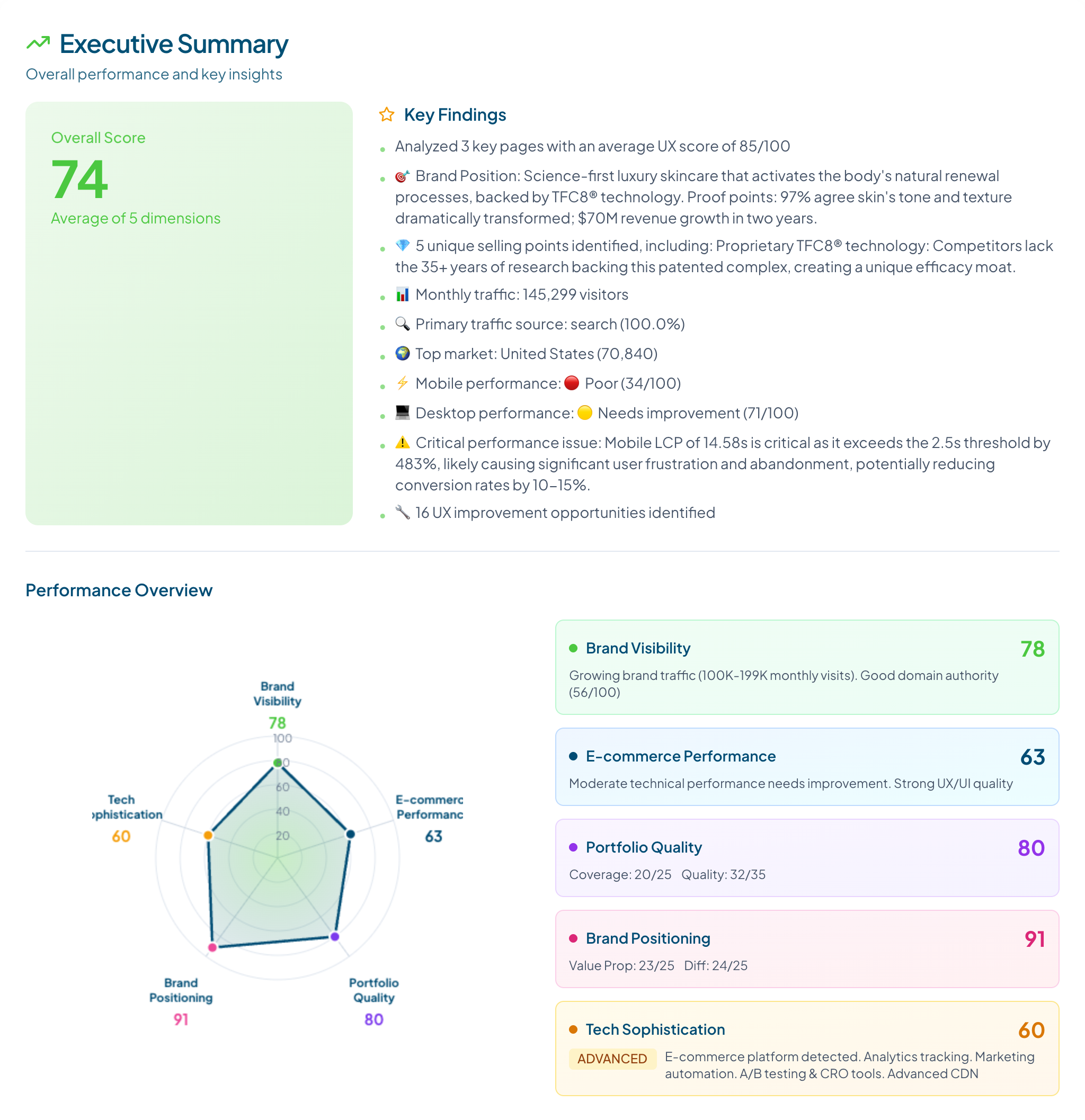
Our Brand Positioning analysis is exceptionally strong, with a Brand Positioning Score of 91/100, reflecting how coherently AB ties product claims, founder credibility, and minimalistic brand language together. This score evaluates narrative clarity, defensibility, and consistency across touchpoints, and AB performs like a category leader.
The brand’s unique selling proposition list is unusually cohesive. The report identifies five clear USPs, led by TFC8® as a proprietary complex backed by decades of research. Competitors can mimic packaging cues and clinical tone. They cannot easily replicate protected technology and a founder story that feels medically earned.
Notable here is how AB avoids overstating. The brand’s language does not lean on hyper-emotional claims. It leans on confidence through restraint. That restraint is a strategy. It signals that the product does not need theatrical persuasion.
Actionable lesson:
If your brand has a proprietary complex, patented delivery system, or even a unique clinical testing approach, elevate it beyond product copy. Make it the organizing principle of your content ecosystem, your hero PDP structure, and your retention program messaging. Treat science as brand architecture, not a footnote. See also: science-led skincare marketing.
2. Minimalist Portfolio Strategy Reduces Cognitive Load and Amplifies Hero Products
Why this matters:
Luxury conversion is often more fragile than mass-market conversion. Over-choice can be lethal, especially when prices are premium.
Our Product Portfolio Quality Score sits at 80/100, suggesting a well-curated range with coherent category logic. The scraped product count shows 20 products across core categories. That number likely reflects the specific pages analyzed rather than AB’s full global assortment. Still, the pattern holds: AB remains structurally restrained relative to many prestige peers.
The brand is especially strong in moisturizers, which aligns with its historic hero narrative around The Cream and The Rich Cream. Even as AB expands into cleansers, eye, and select serums, the portfolio still behaves like a brand with a center of gravity, not a brand chasing every micro-trend.
From a shopper psychology standpoint, this matters because AB’s site design reinforces that simplicity. The homepage highlights hero products and trust signals, while product cards reduce decision friction with clear imagery and quick-view elements.
Actionable lesson:
Audit your portfolio the way a customer experiences it, not the way your product roadmap does. If 70% of your marketing budget is spread across too many SKUs, you are unintentionally weakening your strongest story. AB’s long-term equity suggests that disciplined hero logic can outperform “endless newness.”
3. Loyalty and Auto-Replenish Turn High Price Into Repeatable Value
Why this matters:
For premium skincare, retention is where profitability becomes real. The acquisition cost ceiling is unforgiving.
AB’s E-commerce Performance score of 63/100 suggests strong strategic building blocks with meaningful room to improve. That might sound modest for a luxury leader, but it is a useful reminder. Even iconic brands can have under-optimized digital mechanics.
The report calls out The Club loyalty program and Auto-Replenish as key retention assets. The strategic structure is impressive. Tiering, meaningful savings, and psychological reward loops help turn the high list price into a rational, repeatable purchase decision.
This aligns with the two-system motivation model captured in the analysis. AB wins System 1 desire through luxury and celebrity signals, then secures System 2 justification through science and loyalty math.
Actionable lesson:
If your loyalty program is still mostly “points for discounts,” consider AB’s next-level opportunity and your own. The report recommends experiential rewards. That is smart. In luxury, perks that feel status-based can outperform purely financial incentives. Think invite-only consults, early access to clinical pilots, or private founder sessions.
For Thea Care’s audience, this is also a natural bridge to personalization. For skincare brands, loyalty members represent the richest first-party data layer. That permission can power AI-driven skin journeys, tailored replenishment timing, and concern-specific bundles.
4. The Dua Lipa Collaboration Signals a Controlled Expansion Strategy
Why this matters:
Legacy luxury brands often struggle to grow down-market without weakening prestige. AB appears to be testing a smarter path.
The report identifies Dua Lipa as a strategic lever to attract younger demographics through more accessible pricing. This is consistent with what we see in the broader industry. The most successful luxury skincare brands are building controlled entry ladders, often using collaborations or sub-lines to avoid confusing their main brand promise.
The collaboration reads less like an aggressive pivot than a measured move. AB is using culture to expand the funnel, not to rewrite the brand.
Actionable lesson:
If your brand wants younger customers, do not assume the answer is lowering core prices. Consider using capsule partnerships or limited-edition drops to test demand and gather first-party data. This reduces brand risk and lets you refine messaging before committing to full-range expansion.
5. The Digital Experience Is Strong in Structure but Hurting on Mobile Performance
Why this matters:
Luxury brands can win on story, but lose on patience. Mobile experience is now the primary battlefield for discovery and conversion.
Our UX Quality Score for the analyzed pages is 85/100, reflecting strong design fundamentals. The homepage shows clear value proposition communication, high-contrast CTAs, and prominent trust signals. The collections experience supports efficient browsing with a consistent product grid, sticky filtering on desktop, and Quick Shop elements that reduce friction.
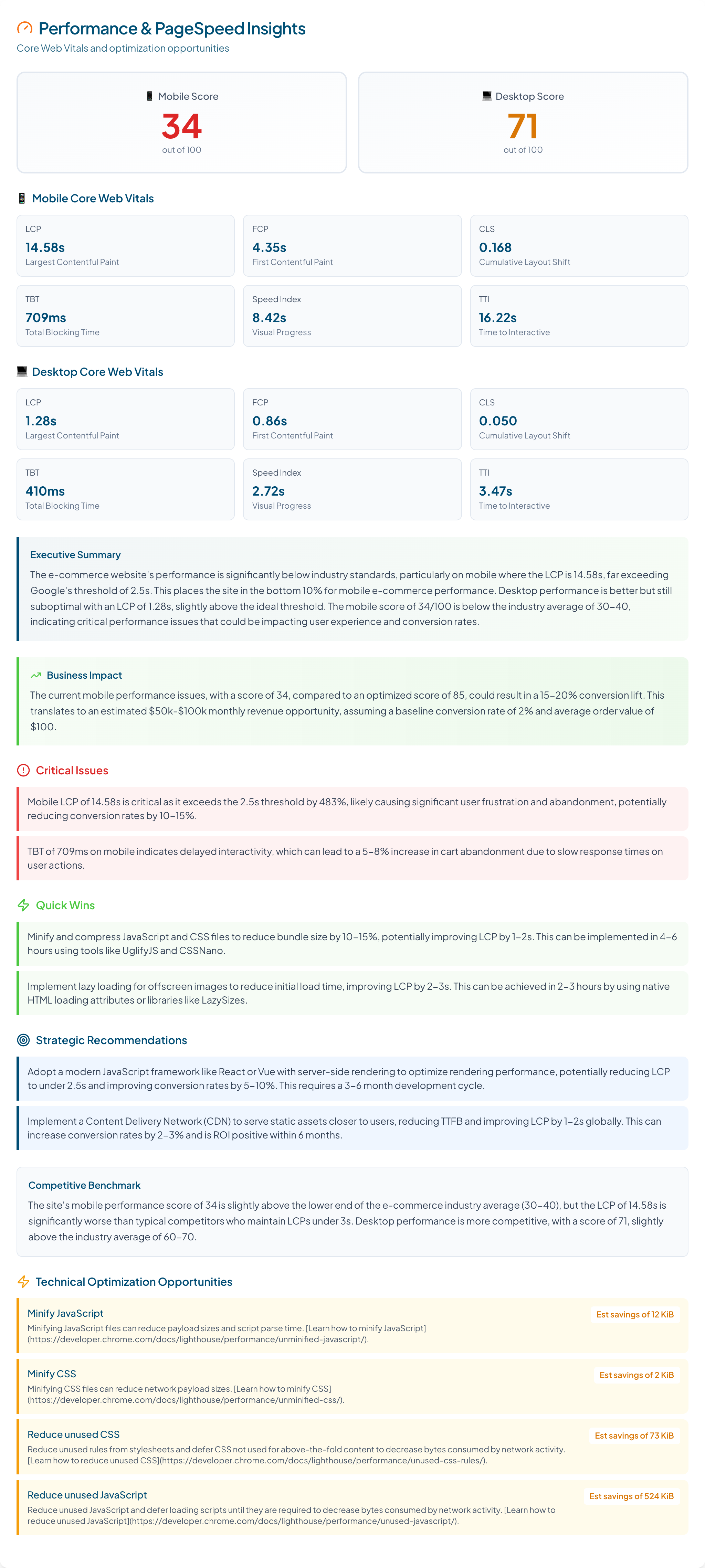
However, the Mobile Score, which evaluates responsive usability, mobile conversion pathways, and technical performance signals, appears constrained by speed issues. Lab testing suggests a mobile performance score of 34/100 with a mobile LCP of 14.58s. PageSpeed lab metrics are not the same as real-world experience, but this gap is large enough to treat as a meaningful risk signal.
The reported impact is also directionally credible. The analysis suggests that performance friction at this level could materially affect abandonment and conversion. Even if the exact percentage range is imperfect, the strategic conclusion is solid.
Where the opportunity is most actionable:
- The hero and product imagery load slower than benchmark expectations.
- The “Find Your Formula” quiz requires login, adding unnecessary friction for new users.
- Mobile filters are not as immediately accessible as desktop filters.
Actionable lesson:
This is where AB’s brand equity could actually be amplified with modern personalization infrastructure. Imagine pairing AB’s science-first identity with a frictionless AI skin analysis entry point that does not require login, then linking outputs to curated bundles and replenishment suggestions. That would align perfectly with the brand’s clinical authority while improving product discovery and conversion.
For most mid-sized skincare brands, this is also the most transferable lesson. You might not have AB’s TFC8. But you can compete on speed, clarity, and intelligent on-site guidance. See also: AI skin analysis case study (Physiogel).
Key Takeaways for Skincare Brand Managers
- Build a defensible science story. Whether it is a proprietary complex, clinical testing model, or dermatologist-led protocol, treat your R&D narrative as a brand asset.
- Protect your hero logic. A focused portfolio can outperform a sprawling one, especially in premium categories.
- Design loyalty as an experience, not just a discount. Pair points with status, access, and personalization.
- Use collaborations as controlled audience expansion. Entry ladders can attract younger customers without destabilizing flagship equity.
- Treat mobile performance and discovery as brand reputation. Fast, guided experiences are now part of luxury.
Conclusion
Augustinus Bader is a masterclass in how scientific authority can become cultural luxury. The brand’s strongest advantage is not only TFC8® as a technology, but TFC8® as a narrative system that organizes the product line, the tone of voice, and customer expectations.
At the same time, our analysis suggests that even category leaders have untapped upside in mobile performance and frictionless personalization. This is a useful reminder for every brand in the 50-250 employee range. Differentiation is not just what you sell. It is how quickly, clearly, and personally you help customers understand why it is right for them.
That is exactly where the next wave of growth is headed. Brands that pair credible science with AI-guided discovery and optimized mobile journeys will set the new standard for premium skincare. See also: the 2026 brand-manager playbook.
If you want to explore how AI-powered skin analysis, personalization, and conversion optimization can increase revenue and reduce digital friction, we can map your highest-impact opportunities in one focused session. We will look at your mobile journey, product discovery flow, and retention mechanics, then identify quick wins and scalable personalization layers.