.avif)
Why Rhode Is Worth Studying Right Now
Rhode Skincare is Hailey Bieber’s minimalist, science-backed skincare brand, founded in 2022 and acquired by e.l.f. Beauty in a 2025 deal valued at up to $1 billion ($800M upfront plus up to $200M earnout). This analysis uses Thea Care’s Brand Performance Framework to score Rhode across visibility, positioning, e-commerce, portfolio, and tech sophistication, and to identify where a brand with near-perfect awareness still leaves conversion on the table.
I have spent the last few years looking at skincare funnels that quietly leak money. Slow mobile sites, pretty but confusing PDPs, generic email flows that talk to everyone and convince no one. Rhode Skincare broke that pattern.
Here is a brand that can dominate Sephora search for its own name and still leave significant conversion and personalization upside on the table. For a marketing or product leader, that combination of strong brand equity and visible gaps is exactly where the most interesting lessons live.
How We Scored Rhode (And Why It Matters)
Before we dive into tactics, a quick word on how we are looking at the brand.
For this analysis, we used Thea Care’s proprietary Brand Performance Framework, the same system we apply across our Brand Analysis Index. It evaluates digital-first skincare brands across five dimensions:
- Brand Visibility Score
- E-commerce Performance Score
- Product Portfolio Quality Score
- Brand Positioning Score
- Tech Sophistication Score
Each score runs from 0 to 100 and blends quantitative data (traffic, engagement, performance diagnostics) with qualitative UX assessments. On top of that, we add a UX Quality Score and channel-specific diagnostics like Mobile Score and Desktop Score, which focus on page speed, responsiveness, and friction in the journey.
These scores are not there to impress investors. They exist to help marketing and product teams quickly see where they are overperforming and where the next 5 to 10 percent of revenue might be hiding.
For Rhode Skincare:
- Overall Score: 72 / 100
- Brand Visibility: 99 / 100
- Brand Positioning: 88 / 100
- Product Portfolio Quality: 74 / 100
- E-commerce Performance: 53 / 100
- Tech Sophistication: 45 / 100
- UX Quality: 85 / 100
In other words, Rhode has built a highly visible, well-positioned brand with solid UX, sitting on top of a relatively basic tech stack and under-optimized performance layer.
.webp)
Brand Overview: Rhode Skincare At A Glance
To understand what those numbers mean in practice, it helps to zoom out.
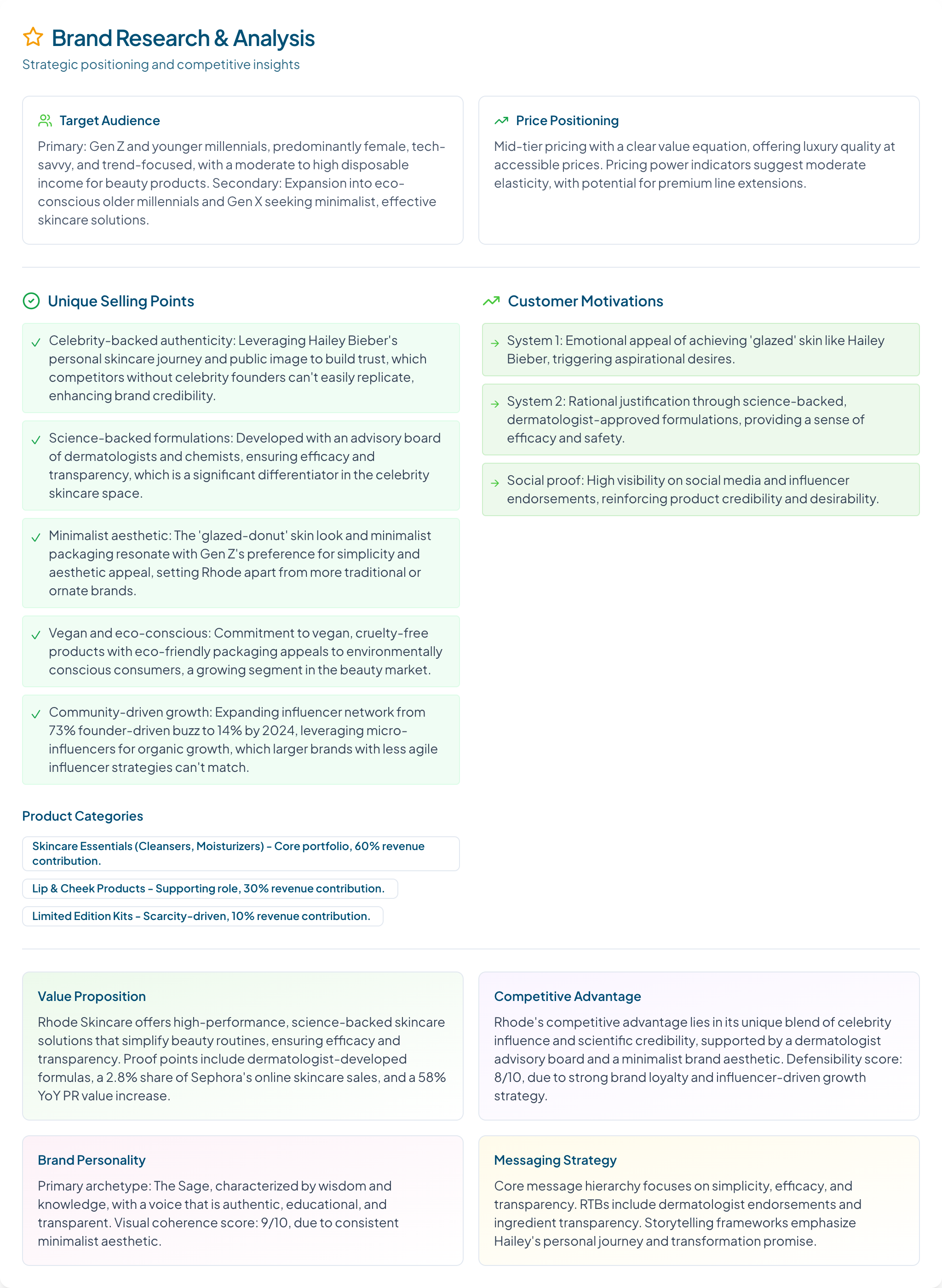
Rhode Skincare is Hailey Bieber’s minimalist, “glazed skin” brand, built around high-performance, science-backed formulas that simplify routines rather than explode them. The promise is clear: fewer products, better actives, visible results, and full transparency.
The value proposition comes through consistently:
- Dermatologist-developed and chemist-advised formulas
- Vegan, cruelty free, and eco conscious positioning
- Aesthetic, “clean girl” packaging that looks as good on a shelf as it does in a bathroom selfie
- Proof points like a 2.8 percent share of Sephora’s online skincare sales at launch and a reported 58 percent year-over-year increase in PR value
The audience skew is exactly where you would expect it to be:
- Primary: Gen Z and younger millennials, mostly female, very online, high social proof sensitivity, comfortable spending on premium beauty if it feels both aspirational and justified by science
- Secondary: Eco-conscious older millennials and Gen X who want fewer, better products and like the idea of a “capsule” routine. This audience overlaps heavily with the skintellectual audience: informed, science-curious shoppers who reward transparency
Where Rhode is genuinely defensible is in the combination of celebrity narrative and scientific backing. Lots of celebrities can put their name on a serum. Far fewer walk in with both a believable skin story and a visible advisory board of dermatologists and chemists behind the formulas.
Insight 1: Creator-Led Awareness and Orchestrated Hype Cycles
If you only skim Rhode’s Instagram, you might think the brand lives off Hailey’s fame. The data tells a different story. Our visibility analysis scored Rhode at 99 out of 100 on Brand Visibility, driven by three elements working in concert: celebrity ignition, a deliberately engineered creator ecosystem, and strong earned media plus search discovery.
Rhode has grown its influencer network from a founder-centric model into a community-driven one. In earlier years, roughly three quarters of the buzz came directly from Hailey. By 2024, that had dropped to a small slice of the total conversation as micro and mid tier creators took over the narrative. Around 1.5 million monthly visits, mostly from branded search, and a solid domain authority in the mid 50s underline how strong this distributed awareness engine has become.
What makes Rhode especially interesting is how this creator system is paired with orchestrated hype cycles and artificial scarcity. The brand works with phased product launches and limited drops that are intentionally hard to get. Being a “Rhodie” is more than making a purchase, it is buying into a lifestyle. The brand signals clean, healthy skin, minimalist aesthetics and thoughtfully designed packaging in elevated color palettes. Rhode products are not confined to the bathroom cabinet, they are designed to be seen: lip tints clipped to phone cases, on the go essentials in handbags, items that make the user instantly recognizable as part of the community.
Hailey Bieber amplifies this by using herself as a strategic product launch engine. In her “Get Ready With Me” content, she subtly integrates unreleased items and lets the community guess what is coming next, from a potential Rhode bronzer to rumored pimple patches. This long tail teasing creates artificial scarcity, sustains anticipation, and turns followers into active participants in the launch process rather than passive observers.
How to apply this insight
If you lead marketing for a 50 to 250 person skincare brand, the takeaway is not “sign a celebrity.” It is:
- Treat your creator community as an acquisition channel you can instrument, not a collection of one off partnerships.
- Design orchestrated hype cycles around launches, with teasing, staged reveals and real scarcity instead of random drops.
- Use formats like “Get Ready With Me” or routine content to seed upcoming products early and let the community speculate.
- Use analytics to track which creators and formats drive engaged sessions and conversions, then reinvest there instead of chasing follower counts alone.
Rhode’s visibility score is high because its awareness engine is diversified, lifestyle driven and compounding. You can reverse engineer that pattern even without a household name.
Insight 2: Science-Backed Positioning That Still Feels Human
A lot of celebrity brands hide behind vague claims like “clean” and “natural.” Rhode leans into a more specific, science forward story. On our Brand Positioning Score, Rhode lands at 88 out of 100, reflecting three things the brand does consistently well: ingredient clarity, expert validation, and an emotional bridge rooted in Hailey’s own sensitive, breakout prone skin and desire for fewer, better products.
You can see this clearly on the Glazing Milk PDP. High resolution imagery and video show texture and finish, awards and dermatologist-developed labels act as shortcuts for trust, and ingredient transparency is front and center rather than tucked away in a tab.
Layered on top is the same lifestyle signal we saw in Insight 1: products built to be seen, not hidden in a cabinet. The science gives buyers permission to take the claims seriously; the lifestyle layer makes the products feel like part of a modern, edited routine rather than a clinical regime. It never feels like a medical brand, more like a very well informed friend who happens to know ingredient lists by heart.
How to apply this insight
If you are building or repositioning a skincare line, Rhode’s approach suggests three practical moves:
- Make your science legible. Use PDPs to answer the two real questions in a customer’s head: “What does this do for my skin?” and “Why should I believe you?”
- Borrow authority strategically. You do not need a full advisory board, but you do need credible validators such as dermatologists, estheticians or clinical study partners.
- Keep the tone human. Let science language support the story instead of replacing it, connecting barrier support, glow and hydration with ceramides, lipids and peptides.
Rhode's strength lies precisely in this combination: hard facts, clearly communicated benefits, and a lifestyle cue that emotionally charges the brand.
Insight 3: A High-Intent Funnel Held Back By Tech Debt
Here is where the story gets interesting.
Our UX Quality Score for Rhode’s key pages is 85 out of 100. The layouts are clean, the journeys are simple, and conversion elements like sticky calls to action, quick add to cart, and thumb-friendly mobile design are all in place.
Yet when we look at the underlying performance and stack, Rhode scores:
- Tech Sophistication: 45 / 100
- E-commerce Performance: 53 / 100
- Mobile Performance Score: 29 / 100
- Desktop Performance Score: 32 / 100
In plain language: the front of the house looks great, but the engine room needs work.
From the stack analysis:
- E-commerce platform: Shopify
- Analytics: Google Analytics, Facebook Pixel, Hotjar
- Tag management: Google Tag Manager
- CDN and hosting: Cloudflare and Amazon Web Services
- Email marketing: Mailchimp
- Front end: jQuery and standard Shopify theme architecture
There is nothing wrong with this setup. It is a very typical DTC stack. It is also relatively bare bones for a brand operating at Rhode’s scale.
Lab-based performance diagnostics flagged several issues that any growth or product team would want to prioritize:
- Mobile Largest Contentful Paint (LCP) in some tests exceeding 20 seconds, with the hero alone measured at about 3.5 seconds in more focused checks
- First Contentful Paint on mobile near 7 seconds in lab conditions
- Total Blocking Time on desktop above 2.7 seconds, indicating heavy or unoptimized scripts
- Product images loading in around 3.2 seconds compared with a 1.5 second benchmark
To be clear, lab numbers are not the same as real user experience and can be skewed by test configuration. But patterns like this usually correlate with higher bounce rates, especially on paid traffic and lower-quality devices. For a brand where 99 percent of traffic appears to originate from search, those performance leaks represent meaningful lost revenue.
Where AI and smarter tooling can help
This is also where Thea Care’s world intersects with Rhode’s story. Once you have:
- Strong brand demand
- A focused product portfolio
- A clean, high-performing experience at the UX layer
The limiting factor often becomes the ability to:
- Load personalized experiences quickly
- Orchestrate scripts, tags, and experiments without slowing everything down
- Serve dynamic content such as AI-driven recommendations or consistent, reliable skin profiles without breaking performance
For Rhode, a pragmatic roadmap could look like:
-
Short term quick wins
- Implement lazy loading for hero and product imagery
- Compress assets and remove unused or noncritical JavaScript
- Use Cloudflare caching and server compression to reduce time to first byte
-
Medium term upgrades
- Move toward a modern front end with server side rendering
- Standardize a personalization layer that can insert recommendations, content blocks, and search results without heavy client-side work
-
Long term differentiation
- Plug in AI-powered experiences like real time skin analysis or hyper-relevant product bundles that justify the extra technical investment
Insight 4: Landing Pages That Convert, Even With Performance Friction
If you want a masterclass in clean, conversion-focused layout, Rhode’s key pages are worth a close look.
Homepage
The homepage shows several strengths that directly support conversion:
- Strong visual hierarchy: Minimalist design with generous white space that reduces cognitive load
- High contrast hero CTA: Exceeds WCAG AA guidelines, which typically lifts click-through
- Quick add to cart from the hero and product rows: Removes a page view from the funnel
- Award and social proof badges on cards: Trust elements embedded in browsing, not hidden on a press page
- Mobile-first patterns: Sticky CTAs and a 2-column mobile grid that respect touch targets and Fitts’s Law
The homepage contributes heavily to that 85 out of 100 UX Quality Score. The flip side is that navigation and discovery are still static: no predictive search, no personalized merchandising, no quiz or guided selling. For a high-intent brand with clear hero products, smarter search that understands intent like “dull skin,” “redness,” or “minimal routine” would likely lift search-to-purchase conversion.
Collections Page
The collections page continues the theme: quick add to cart across the grid lowers friction, “limited edition” and “new” labels create ethical urgency, and a 2-column mobile grid respects readability. The weak spots are again tech rather than UX: image loading can be improved with lazy loading and WebP, filters could be stickier and more prominent, and there is no dynamic ordering based on user behavior or predicted intent.
Product Detail Page
The Glazing Milk PDP is one of Rhode’s strongest pages: high quality imagery and Hailey-fronted video showing texture and finish, award badges and dermatologist-developed indicators directly under the product name, and a sticky add to cart that stays visible while users scroll through ingredients and usage. Where the PDP can evolve is in social proof and relevance: more user generated content like photo reviews, contextual AI-driven recommendations (“if you love Glazing Milk, customers with dry skin often add X”), and ethical scarcity indicators when stock is genuinely limited. Measuring these tweaks against AOV and conversion is what turns design intuition into a defensible business case.
How to apply this insight
The big lesson is that Rhode does not overcomplicate its landing pages. It removes choices instead of adding them. The next layer of growth will not come from more banners or modules. It will come from:
- Making existing pages faster
- Making discovery more intelligent
- Making recommendations more relevant
For many brands, that is a healthier starting point than a complete redesign.
Insight 5: A Focused Product Portfolio That Is Ready For Personalization
Our Product Portfolio Quality Score for Rhode sits at 74 out of 100. The portfolio is tight, purposeful, and aligned with the brand’s promise.
From the data:
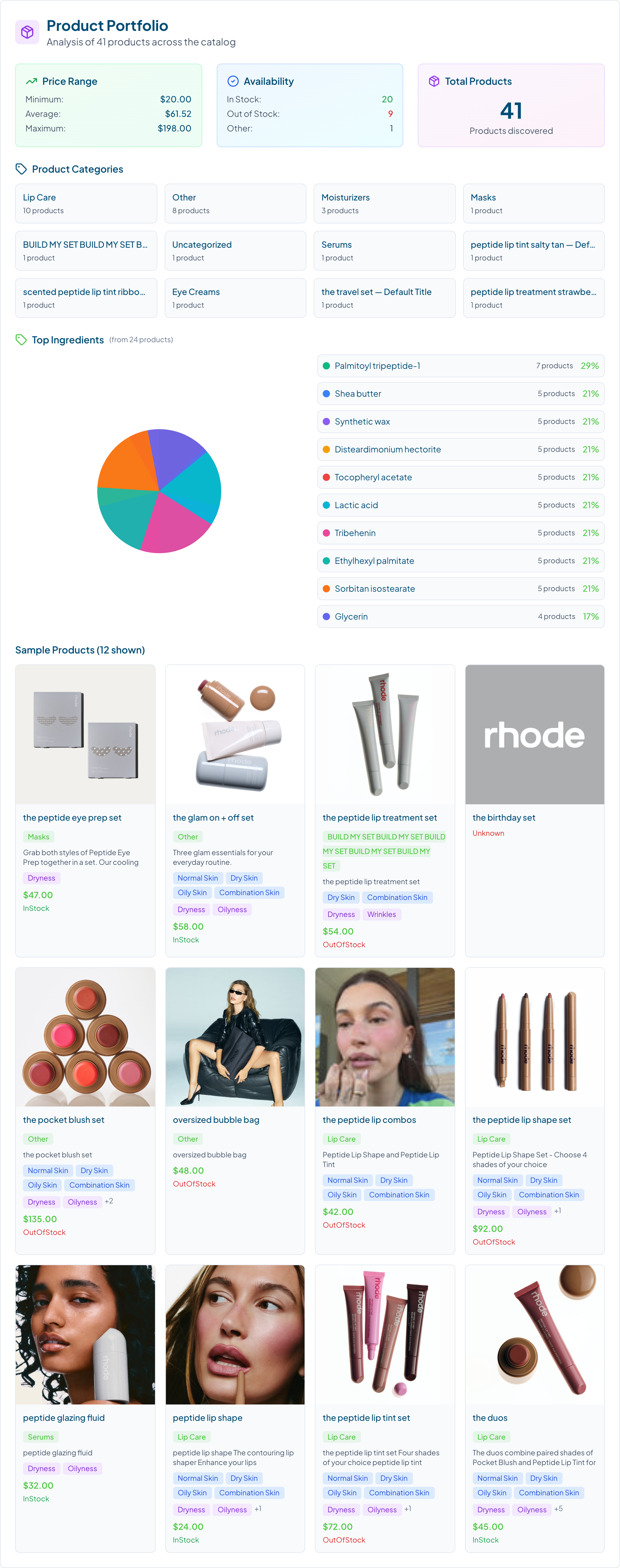
- Total products: 44
- Average price: Around 62 dollars
- Price range: Approximately 20 to 198 dollars, from single lip products to higher-value sets and bundles
- Key categories: Lip care, moisturizers, serums, eye care, masks, and curated sets
Examples from the catalog include:
- The peptide eye prep set at 47 dollars
- The glam on + off set at 58 dollars
- The peptide lip treatment set at 54 dollars
- The pocket blush set at 135 dollars
- The peptide glazing fluid at 32 dollars
- The peptide lip shape at 24 dollars
This is not an endless aisle. It is a curated wardrobe. That is a strategic choice, and it fits:
- The brand’s promise of an edited, minimalist routine
- The audience’s preference for simple decisions
- The visual consistency of the site and social content
From a revenue perspective, the sets and bundles are especially interesting. They push the average order value up significantly while staying consistent with the “build your glazed routine” story.
Where personalization changes the game
Right now, product discovery is mostly manual. Users browse, read, and decide. With a focused catalog, that is not a terrible experience. It is just not as powerful as it could be.
For a brand like Rhode, AI-powered personalization can:
- Turn the catalog into dynamic routines, for example “barrier repair routine,” “pregnancy-safe glow routine,” or “oil control glaze routine”
- Use a 30 to 60 second quiz or AI skin analysis flow to map users into those routines
- Adapt bundles in real time based on a user’s skin type, climate, and budget
This is exactly where tools like Thea Care can help brands translate a good product architecture into a high-converting, personalized shopping journey. The technology does the heavy lifting in the background. What the consumer sees is a routine that feels like it was designed just for them. See also: AOV uplift from AI personalization.
Key Takeaways For Skincare Brand Teams
If you are leading growth, digital, or product at a skincare brand, Rhode’s analysis highlights five practical lessons. See also: the 2026 differentiation playbook.
- Diversify your awareness engine. Build a creator ecosystem that does not depend on any one profile, even if you have a strong founder story. Treat creators like performance partners, not vanity placements.
- Marry science with story. Use PDPs and content to connect ingredients to results in plain language while retaining emotional resonance.
- Fix the engine under the hood. Do not let slow mobile performance quietly tax your most engaged users. Technical debt is a conversion problem, not just an engineering problem.
- Keep the UX simple, then make it smarter. Rhode’s UX shows that clean design and clear CTAs are table stakes. The next gains come from intelligent search, dynamic merchandising, and personalization.
- Use AI to turn products into routines. A focused catalog is the perfect foundation for AI-driven recommendations. Personalization is not about overwhelming users. It is about making the right next step obvious.
Where AI-Powered Personalization Fits In
When we built Thea Care’s analysis tooling, one pattern showed up again and again. The brands that win over the next five years are rarely the ones with the most products or the biggest teams. They are the ones that:
- Understand their audience at a granular level
- Translate that understanding into smart digital journeys
- Use AI to scale the kind of advice that used to only happen in a spa or at a beauty counter
Rhode has already done much of the hard work. The brand is visible, trusted, and loved. The UX is clean. The product portfolio is tight. The room for growth is in the layers that are hard to copy:
- An AI-powered skin analysis that feels like a one-to-one consultation
- Product recommendations that respect both skin biology and user preferences
- Predictive search and merchandising that anticipate intent instead of reacting to it
That is exactly the gap Thea Care exists to fill for brands like Rhode and for the next generation of digital-first skincare leaders.
Conclusion
Rhode Skincare is not perfect. It is successful in a very specific way.
On one side, you have a brand that has nailed visibility, carved out defensible positioning in a crowded celebrity space, and built an experience that feels coherent from Instagram to checkout. On the other, you have measurable performance issues, a relatively simple tech stack, and an almost complete absence of personalization.
For Rhode, this is good news. It means there is still plenty of upside without needing to reinvent the brand. For you, as a marketing or product leader, it offers a clear blueprint: build strong foundations, then use data and AI to turn a good experience into a compounding advantage.
The brands that do this early will not just win more customers. They will build relationships with those customers that competitors cannot easily disrupt.
If you want to see how AI-powered skin analysis and personalization could increase your revenue and improve customer experience, let us talk.
In a 30 minute discovery call, we will:
- Map your current customer journey from first touch to repeat purchase
- Identify 2 to 3 high-impact personalization opportunities
- Walk through how Thea Care’s AI layer can plug into your existing stack
No generic pitch. Just a focused conversation about what is realistically possible for your brand in the next 6 to 12 months.