An AI skin analysis is a computer vision and rule-based recommendation system that evaluates a shopper's skin from a selfie and proposes a complete personalised routine in seconds. It replaces the static skin quizzes that beauty brands have used for years to capture consultation intent, hard-coded decision trees that ask a few questions and return a fixed product set, with a live skin assessment that adapts to the actual face on camera.
Dr. Emi, a dermatologist-led DACH skincare brand, took Thea Care's AI skin analysis live on its Shopify shop in May 2026, replacing the existing static skin quiz on the same dedicated subdomain. In the first measurement window, the skin analysis was running at roughly three times the quiz's conversion rate and more than four times the revenue per user. This case study covers what changed on conversion rate, AOV, ARPU, and ROI on the licence fee, why the structural difference between a quiz and an AI analysis matters, and what the numbers mean for any brand currently running a quiz on its shop.
At a glance: the five metrics that matter
Visitors who reach the skin analysis convert roughly three times as often as visitors who used the previous quiz, and spend on average 27% more per order. The combined effect is a fourfold lift in revenue per user. Against the licence fee of the Standard tier, the skin analysis delivers an incremental profit ROI of around 7.8x and a revenue multiple of about 10.8x on every euro invested. The conversion, AOV, and ARPU lifts compare the skin analysis funnel with the previous quiz baseline that Dr. Emi measured internally. The two ROI values are measured in rollout over 61 days (30 July to 28 September 2026) against Dr. Emi's own shop baseline.
For context, even the quiz was already lifting AOV meaningfully above Dr. Emi's site-wide baseline, so the quiz was doing real work before the swap. The point of this case study is that the structural jump from quiz to AI is a different category of lift than the jump from no consultation to a quiz.
Why a dermatologist-led brand replaced a working skin quiz
Dr. Emi's skin quiz was not broken. Customers were engaging with the consultation surface, and the quiz was already lifting average order value meaningfully above the bare shop baseline. The reason to replace it was the ceiling every static quiz hits: it asks the same questions, runs the same hard-coded rules, and returns the same product sets, regardless of what the person on the other side of the screen actually looks like.
For a dermatologist-led brand built on the credibility of clinical skin assessment, that ceiling shows up in a specific place: a single-digit start-to-order conversion rate. Most customers who started the quiz engaged enough to begin a consultation but did not trust the resulting recommendation enough to buy. The recommendation logic was binary, did not adapt to actual skin state, and pushed safe single-product picks. Average order values reflected that pattern, an upsell over the bare shop baseline but well below what a proper routine recommendation could earn.
This is the gap any beauty brand running a quiz today should look at honestly. A quiz captures intent. A quiz does not earn trust. McKinsey's research on personalisation in retail reports that brands using consultation-led recommendation see 40% higher revenue from personalisation efforts than slower-moving competitors. The "consultation-led" part is doing the work, and a static quiz delivers a small fraction of what real consultation looks like.
How Dr. Emi integrated Thea Care
Thea Care replaced the existing quiz on the same dedicated subdomain (hautanalyse.dr-emiskin.de). The interface was customised to Dr. Emi's visual identity, mobile-first by default, and connected to the Dr. Emi product catalogue so recommendations map to specific skin needs and routine logic. Customers upload a selfie, receive an easy-to-understand skin report covering hydration, redness, pigmentation, wrinkles, and other parameters, and are guided into a complete personalised regimen rather than a single-product guess.
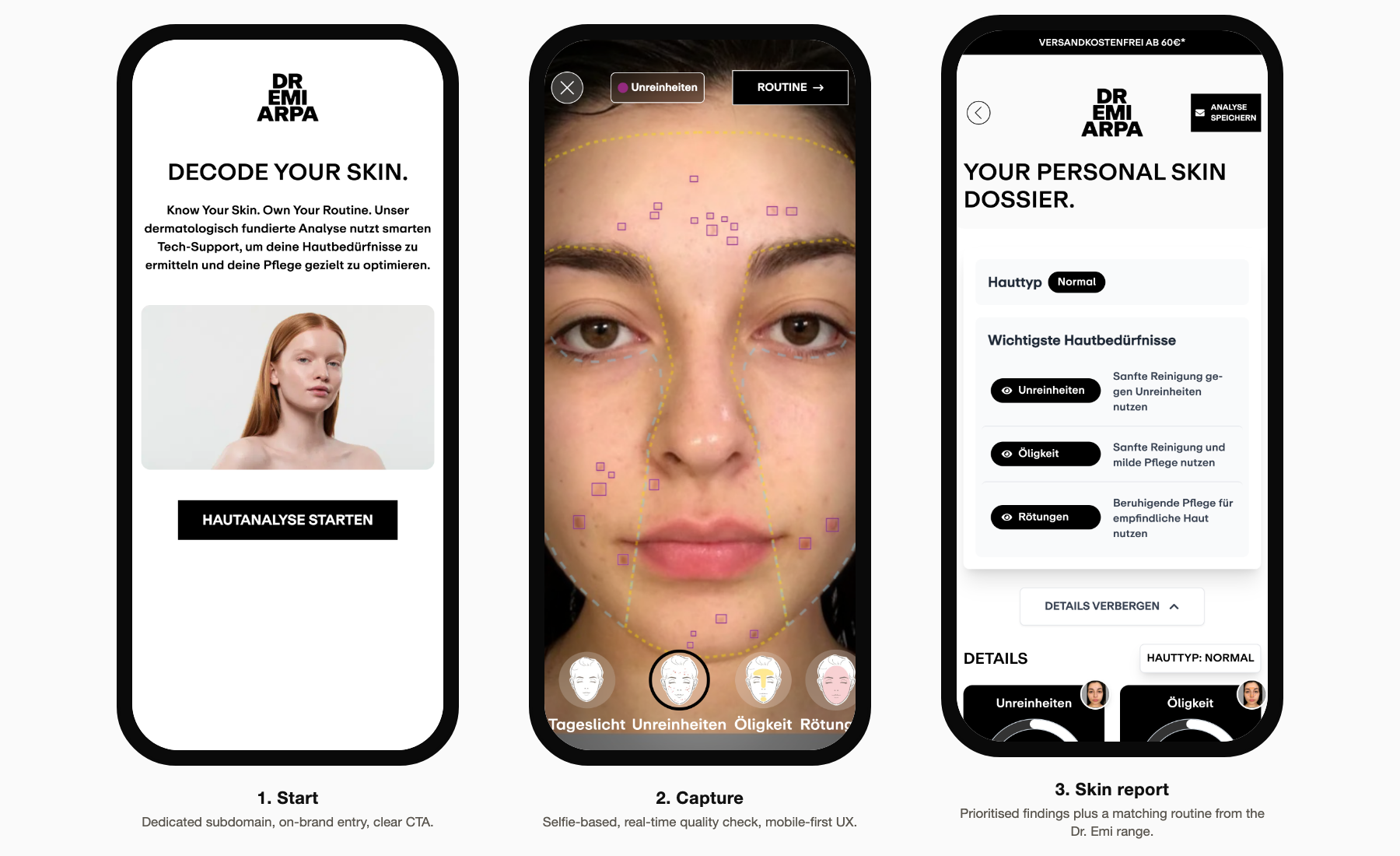
A few specifics matter for brands evaluating a similar setup:
- Shopify shop, untouched core. Dr. Emi's webshop runs on Shopify. The skin analysis was deployed without modifying the core shop setup. Integration time was under six weeks.
- Same-subdomain replacement. No URL change, no new tracking domain, no break in any campaign UTMs already pointing at the consultation surface. Dr. Emi's existing performance marketing kept working on day one.
- Analysis plus one targeted question. The core is the AI skin analysis from the selfie, complemented by one short targeted question. It is not an either-or between quiz and analysis, it is both, with a clear focus on the analysis.
- Rule-based recommendation steering. A configurable rule layer lets Dr. Emi steer which products and routines surface for which skin profiles, including age-based logic, premium-line boosts, and exclusion rules.
- Klaviyo integration with cross-session attribution. At the end of the report, visitors can save their personalised routine via email, handed off to Klaviyo. A meaningful share of purchases attributed to the skin analysis lands outside the original session, the email funnel is doing real work. See our deeper post on personalised skincare with AI for how this lifecycle compounds.
- GDPR posture. Images are processed on EU-resident infrastructure with explicit consent at capture. Our post on how accurate AI skin analysis is covers the data-handling specifics.
What changed for Dr. Emi
Conversion rate roughly tripled
Visitors who start the skin analysis convert at roughly three times the rate of the previous quiz, a +232% lift on the quiz baseline. The mechanism is straightforward: the skin analysis ends with a coherent, dermatology-aligned routine grounded in the actual skin assessment, not in a quiz answer. The shopper sees both what to buy and why, and the why now carries the weight of a real skin reading. Comparable lifts show up across the Thea Care portfolio, see the NKM Naturkosmetik München case study and the Weleda case study.
AOV up 27% because routines beat single products, even when the quiz was already personalising
The quiz already delivered a sizeable AOV lift over Dr. Emi's site-wide baseline. The skin analysis adds another +27% on top of that. This is the more honest comparison than measuring against a non-personalised baseline: it isolates the structural difference between rules-based personalisation and AI-based personalisation. The structural drivers:
- Routine logic instead of single product. The skin analysis recommends a coherent multi-product routine, cleansing, day care, treatments, rather than one hero product.
- Premium steering with confidence. A skin reading the customer trusts unlocks higher price points. The quiz could not deliver that confidence layer.
Stacked over the bare shop baseline, the skin analysis delivers a substantially higher basket value than either the quiz or the unguided shop, the structural effect of layering routine-based AI personalisation on top of what the quiz had already done. The case study leads with the quiz comparison because it is the honest comparison: Dr. Emi swapped quiz for skin analysis, not "no consultation" for skin analysis.
ARPU per user up more than 4x because the two effects compound
Conversion rate and AOV multiply. Revenue per skin analysis start lands at roughly four times the revenue per quiz start, a +320% lift. This is the central commercial metric: every consultation surface visit now produces over four times the revenue it did under the quiz. For a brand allocating performance budget against consultation traffic, that changes the spreadsheet.
ROI on the licence fee
The licence fee for the skin analysis is a fixed investment. Against that, the incremental revenue that would not have happened without the skin analysis is the return side, the revenue of the skin analysis minus what the same visits would have produced at the shop's own conversion rate and basket value. Two ROI metrics matter, they answer different questions.
Incremental Profit ROI: ~7.8x. For every euro invested, the skin analysis returns approximately €7.80 in incremental gross profit, assuming a gross margin of 72%. This is the metric finance and procurement care about: licence fee against the profit contribution that would not exist without the skin analysis.
Revenue Multiple on Cost: ~10.8x. For every euro invested, the skin analysis generates approximately €10.80 in incremental revenue. This is the metric used to size the lever versus other performance-marketing investments (paid social, search, CRM campaigns).
Both values are measured, not extrapolated: they cover 61 days of rollout, with the licence fee prorated to the same window. They count purchases made in the analysis session as well as purchases that land later through the email funnel or a return visit. Skin analysis users choose to start a consultation and are more engaged than the average shop visitor, so the shop comparison describes what the skin analysis funnel returns, while the quiz comparison above is the like-for-like view. At comparable portfolio brands, both ROI metrics in years two and three sit stably above year one as recommendation logic, email automation, and assortment steering are tuned further in ongoing rollout.
The repurchase signal is already visible
Four months after launch, the repurchase signal is measurable. Of the customers whose first Dr. Emi order came through the skin analysis, about one in three has already ordered again. Among new customers, those acquired through the skin analysis placed a second order within 30 days 2.8 times as often as new customers who came through the shop alone, a statistically significant difference. That is meaningful for a brand whose unit economics scale with routine adoption: the skin analysis works as a customer-acquisition mechanism, not just a conversion lift.
Why this case study matters for brands currently running a skin quiz
A pattern worth naming: the gap between "no consultation" and "skin quiz" is real, the quiz already delivered Dr. Emi a meaningful AOV lift over baseline. The gap between "skin quiz" and "AI skin analysis" is structurally larger, the skin analysis triples conversion and more than quadruples revenue per user on top of what the quiz already delivered.
For any brand currently running a quiz or static recommendation engine, this is the upgrade math:
- You already proved consultation works on your shop. The quiz is the evidence. The ceiling on what a quiz can do is now visible.
- AI personalisation is not an incremental improvement, it is a category change. A tripled CR and quadrupled ARPU per user are not the kind of numbers you get from tuning quiz copy or adding a question.
- The integration cost is bounded. Dr. Emi swapped quiz for skin analysis on the same subdomain in under six weeks, no shop changes, no campaign breakage.
- The ROI math is honest on the Standard tier. ~7.8x incremental gross profit and ~10.8x revenue multiple on the licence fee, measured over 61 days in rollout.
What other beauty brands can take from the Dr. Emi setup
- A quiz proves consultation intent. AI delivers on it. If your quiz is converting at all, the skin analysis will convert structurally higher. The intent was always there.
- AOV is where rules-based vs AI-based personalisation diverges cleanly. The quiz already delivered a sizeable AOV lift over the bare shop. The skin analysis adds +27% on top of that. Both are personalised, only one earns trust.
- ARPU per user is the metric to size against. Once CR and AOV both move, the per-visit revenue lift is the number that resizes the performance marketing case.
- Cross-session attribution catches most of the lifecycle. Without it, you under-credit the email funnel and overstate the case for last-click attribution. Build it in from day one.
- Shopify integration is fast. Six weeks, no core changes.
Frequently asked questions
How does an AI skin analysis differ from a skin quiz?
A skin quiz asks a fixed set of questions and returns a fixed product set based on hard-coded rules. An AI skin analysis evaluates the actual skin from a selfie, detects parameters like hydration, redness, pigmentation, and wrinkles, and returns a personalised routine grounded in that reading. The quiz captures intent. The AI earns trust.
Why is the lift bigger when replacing a quiz than when adding consultation from scratch?
It is not bigger, it is structurally different. Adding consultation to a shop that had none typically lifts conversion 2-3x (Weleda, NKM). Replacing a quiz with AI in Dr. Emi's case lifted CR roughly 3.3x on top of what the quiz already produced. The Dr. Emi headline numbers (+232% CR, +320% ARPU) are vs the quiz baseline. Measured against the bare site-wide baseline (no consultation at all), the stacked lift is larger again, because the quiz was already pulling AOV up meaningfully over the unguided shop.
What is a realistic ROI on AI skin analysis for a Shopify skincare brand?
In the Dr. Emi case, the incremental gross-profit ROI on the licence fee of the Standard tier is around 7.8x, and the revenue multiple is around 10.8x, measured over 61 days in rollout against the shop baseline and assuming a 72% gross margin. Returns vary by brand, traffic, and basket size, so the Dr. Emi values sit at the upper end of the Thea Care portfolio rather than being a guaranteed outcome.
How long does it take to integrate AI skin analysis into a Shopify shop?
Dr. Emi integrated Thea Care on its Shopify shop in under six weeks, without modifying the core shop setup. The skin analysis ran on the same subdomain that previously hosted the quiz, so no URL or campaign change was needed. The typical integration window across the portfolio (Shopify, Spryker, Shopware) is four to eight weeks.
Does the skin analysis work in dermatologist-led brands specifically?
Yes. The skin analysis is dermatologically grounded, the parameters detected map to what a practitioner would assess in person. For a dermatologist-led brand, the skin analysis extends the brand's clinical positioning into every digital session, rather than diluting it through a static quiz. The Dr. Emi numbers are the first measured data point on this thesis.
What is the difference between Profit ROI and Revenue Multiple?
Profit ROI is incremental gross profit divided by the licence fee. It answers "is this investment worth more than what we spend on it?", the question finance and procurement care about. Revenue Multiple is incremental revenue divided by the licence fee. It answers "how much revenue lever does this deliver?", the question marketing and CRO care about when sizing this against paid channels.
Are the Dr. Emi numbers stable enough to project forward?
The ROI values were refreshed in September 2026, more than four months after launch, and cover 61 days of rollout rather than a launch spike. The return on the licence fee rose compared with the first measurement window, because purchases that land after the analysis session became measurable. The repurchase signal on customers acquired through the skin analysis is consistent with portfolio patterns. We will refresh the numbers again at the 180-day mark.
Try it live
The Dr. Emi skin analysis is live at hautanalyse.dr-emiskin.de. Upload a selfie, see the skin report, review the personalised routine. The whole flow takes under two minutes.
Voices from the partnership
"Replacing a static quiz with real AI personalisation is a different category of lift. CR triples, AOV climbs, and the two compound into a fourfold ARPU lift. That is what the structural difference between rules and AI looks like in commercial terms." Nataniel Müller, CEO, Thea Care
"The skin analysis is dermatologically grounded, that is what lets the customer trust the routine, not just the recommendation. The quiz could not deliver that." Dr. Suzan Stürmer, CMO, Thea Care
Book a discovery call with Thea Care to see what a setup like this can deliver for your brand.