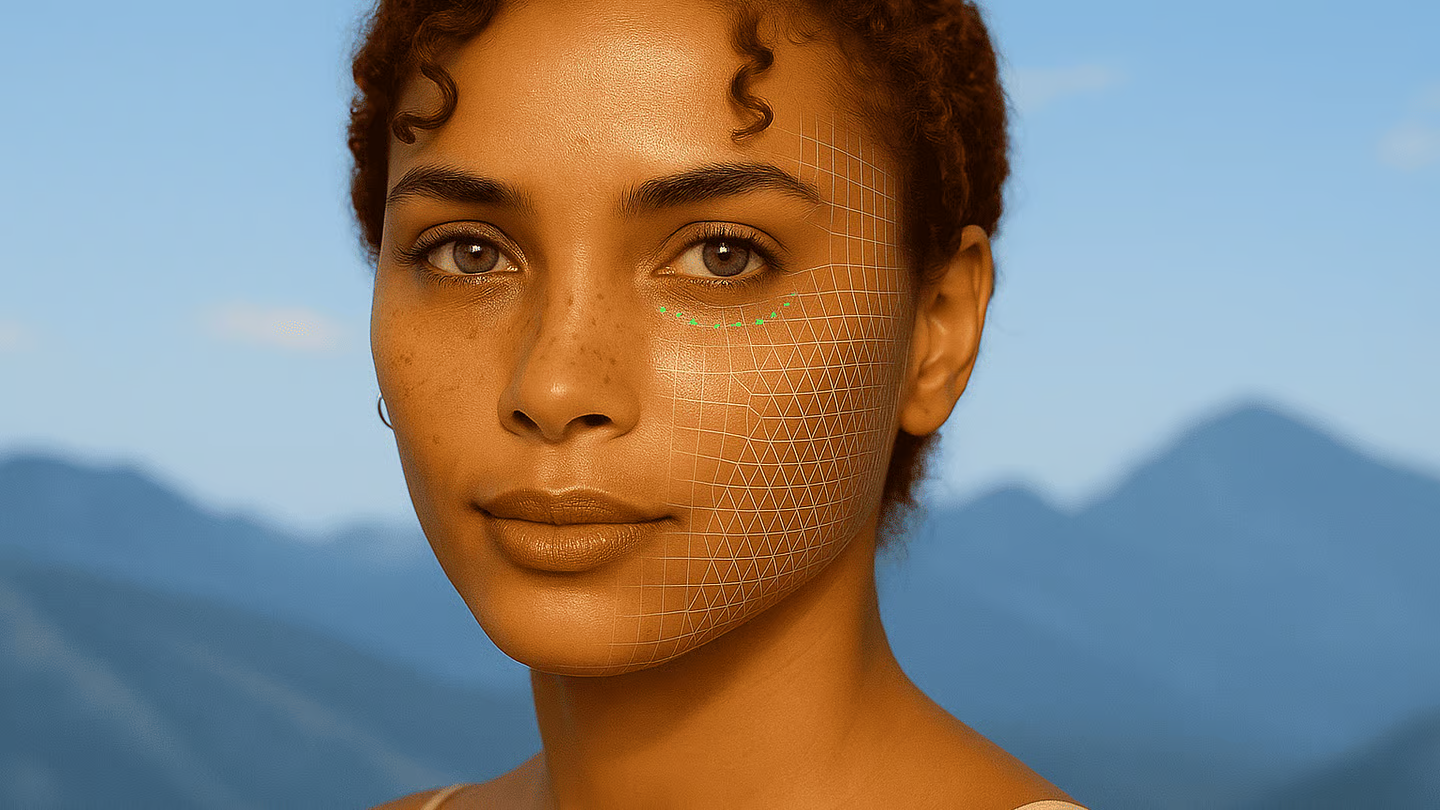
AI skin analysis is a computer vision and rule-based recommendation system that evaluates a shopper's skin from a selfie and proposes a complete personalised routine in seconds. Skincare brands embed it on their webshop to replicate the depth of an in-store consultation at the scale of every digital session, instead of relying on category filters and product copy alone.
Weleda, one of Europe's most recognised natural-skincare brands, took Thea Care's AI skin analysis live on its Weleda webshop in November 2025. After a successful initial validation phase, the solution now runs in active rollout under a multi-year partnership. This case study covers what changed for Weleda on conversion rate, average order value (AOV), average revenue per user (ARPU), and ROI on the licence fee, what those numbers mean structurally, and what other beauty brands can take from the setup.
At a glance: the five metrics that matter
Skin-analysis users on the Weleda shop convert roughly three times as often as the rest of the shop's traffic and spend on average 47% more per order. The combined effect is a fourfold lift in revenue per user. Against the licence fee, the skin analysis delivers an incremental profit ROI of around 8x and a revenue multiple of 12x on every euro invested. All values refer to the skin analysis funnel compared against Weleda's own shop baseline (CR and AOV that Weleda measures internally), stated as relative deltas.
Why a natural-skincare leader needed a digital consultation layer
Weleda's skincare assortment online is dense: multiple lines for gentle naturals, anti-ageing, sensitive skin, and concern-specific formulations. The brand's in-store and pharmacy consultations have been part of its DNA for decades. Online, the shop traditionally answered "which product fits my skin?" through categories, filters, and product detail pages.
That works for visitors with clear purchase intent. For the much larger group of shoppers who want guidance, the visitors who would have asked a Beraterin in-store, the path between category page and product detail left a gap. Hesitation went up, baskets shrank to single safe items, and routine adoption stalled. For a brand whose unit economics scale strongly with routine purchases rather than one-off products, that gap meant leaving revenue, repeat rate, and CRM value on the table. The pattern is well-documented across DACH e-commerce: Statista's retail e-commerce conversion data shows beauty and personal-care brands sitting under 2% baseline conversion globally, with multi-product baskets contributing the bulk of revenue.
As Weleda planned its rollout to France and further markets, it needed to make this consultation experience available in every digital session at scale, without growing human consultation capacity proportionally.
How Weleda integrated Thea Care
Thea Care was integrated as a white-labeled, on-brand AI skin analysis and product-recommendation experience on a dedicated Weleda subdomain. The interface was customised to Weleda's visual identity, mobile-first by default, and connected to Weleda's product catalogue so recommendations map to specific skin needs and routine logic. Customers upload a selfie, receive an easy-to-understand skin report, and are guided into a complete personalised regimen rather than a single-product guess.
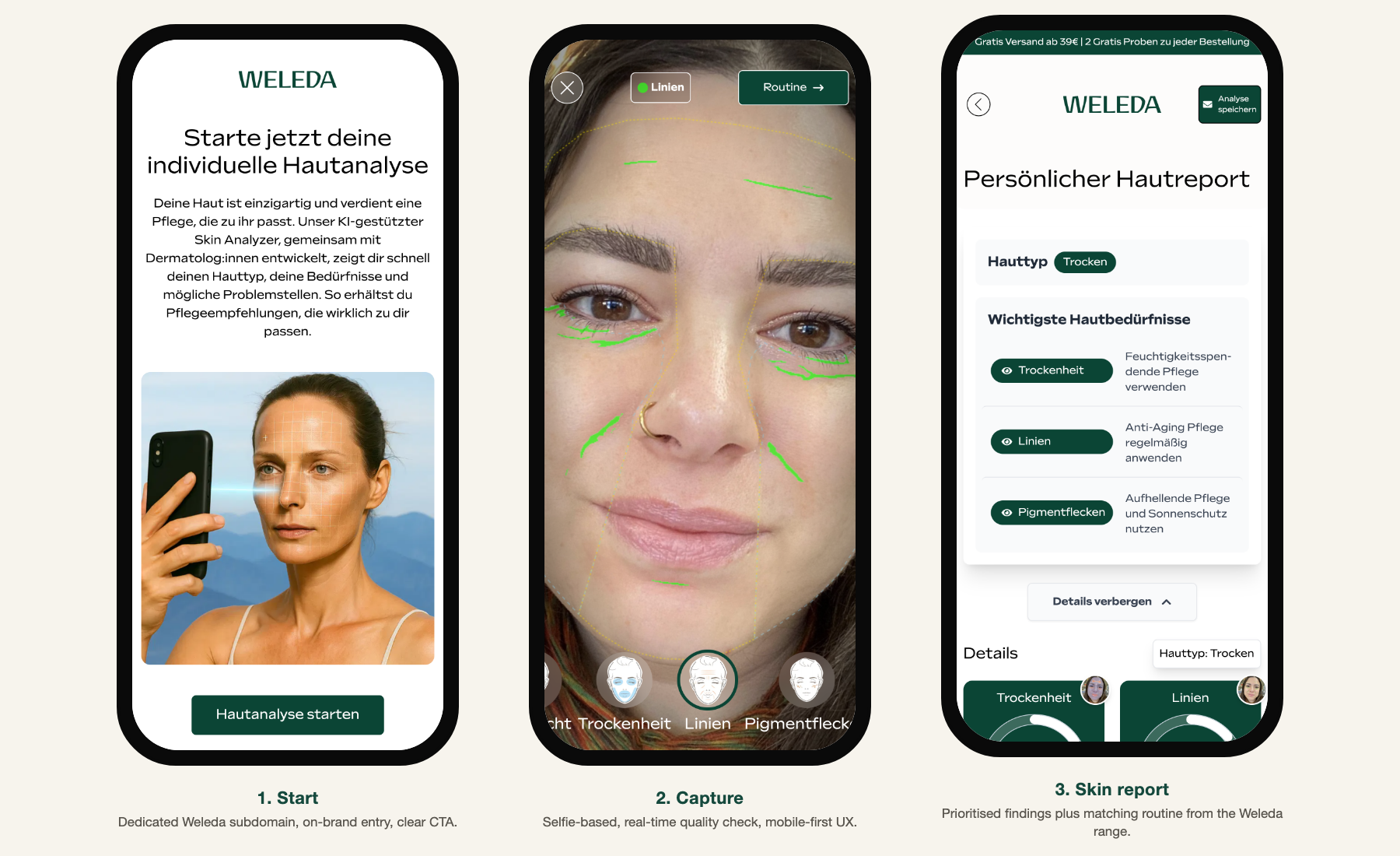
A few specifics matter for brands evaluating a similar setup:
- Spryker shop, untouched core. Weleda's webshop runs on Spryker. The skin analysis was deployed without modifying the core shop setup. Integration time was under six weeks.
- Rule-based recommendation steering. A configurable rule layer lets Weleda steer which products and routines surface for which skin profiles, including age-based logic, premium-line boosts, and product-exclusion rules for younger audiences.
- Email handover. At the end of the report, users can save their personalised routine via email. This creates a clean, high-intent CRM touchpoint with explicit consent, the basis for the rest of the lifecycle.
- GDPR posture. Images are processed on EU-resident infrastructure; personal data handling is documented for the brand's compliance team. See our deeper post on GDPR and AI skin analysis for how this works in practice.
What changed for Weleda
Conversion rate roughly tripled
Users who complete a skin analysis convert roughly three times as often as the average Weleda shop visitor. In relative terms, a +200% lift on the storefront baseline.
The effect is structural, not surprising. A coherent personalised routine at the end of the report removes the uncertainty about product choice. The shopper sees both what to buy and why. Comparable lifts show up across the Thea Care portfolio: see the NKM Naturkosmetik München case study and the Judith Williams Cosmetics case study.
AOV up 47% because routines beat single products
Skin-analysis orders are on average around 47% larger than the average Weleda basket. Two structural mechanics drive this, both built in deliberately:
- Routine logic instead of single product. The skin analysis recommends a coherent multi-product routine, cleansing, day care, treatments, rather than one hero product.
- Premium steering. Through the rule-based recommendation logic, Weleda can boost premium lines for matching skin profiles without compromising brand perception.
This is consistent with broader research on guided selling. McKinsey's research on personalisation in retail reports that brands using consultation-led recommendation see 40% higher revenue from personalisation efforts than slower-moving competitors, a comparable structural multiplier.
ARPU around 4x because the two effects compound
Conversion rate and AOV multiply. Revenue per skin-analysis user lands at roughly four times the revenue per average shop visitor. This is the central ARPU metric Weleda uses internally to evaluate the contribution of the skin analysis to performance marketing and CRO.
ROI on the licence fee
The licence fee for the skin analysis is a fixed investment. Against that, the incremental revenue that would not have happened without the skin analysis is the return side. Two ROI metrics matter, they answer different questions.
Incremental Profit ROI: ~8x. For every euro invested, the skin analysis returns approximately €8 in incremental gross profit. This is the metric used to evaluate the investment cleanly: licence fee against the profit contribution that would not exist without the skin analysis. Margin assumption: 72%.
Revenue Multiple on Cost: ~12x. For every euro invested, the skin analysis generates approximately €12 in incremental revenue. This is the metric used to size the lever versus other performance-marketing investments (paid social, search, CRM campaigns).
Both values are conservative. A meaningful share of skin-analysis-driven purchases comes back through the email funnel or cross-session, where standard web tracking systematically under-attributes. At comparable portfolio brands, both ROI metrics in years two and three sit stably above year one as recommendation logic, email automation, and assortment steering are tuned further in ongoing rollout.
The strongest email signal in the Thea Care portfolio
Across all Thea Care customers, Weleda stands out on one metric in particular: the share of skin-analysis users who save their report by email. At Weleda, this share sits +44% above the portfolio benchmark.
In absolute terms, Weleda is building a top-tier newsletter and CRM pool through the skin analysis, without a single pop-up. These users actively requested a personalised recommendation, making them many times more valuable than cold-collected email addresses. An initial campaign mail to this segment in December 2025 produced a measurable incremental revenue contribution, demonstrating that the CRM value of the skin analysis goes well beyond on-session conversion.
This is the second-order revenue line that most brands miss when they evaluate AI skin analysis purely on storefront uplift.
Why brand trust matters more than features in this category
A pattern worth naming: Weleda sits above the Thea Care portfolio benchmark at both top-of-funnel acceptance and at analysis completion. Funnel completion to the personalised skin report runs ~5% above the portfolio average; the share of users who finish the analysis once they start it runs ~5% above as well.
These deltas come from brand trust, not from product differences. The skin analysis is the same product on every brand's domain. What differs is how willing the visitor is to grant camera access and finish the flow on a brand they trust. For natural-skincare buyers, Weleda has decades of equity; that equity translates one-to-one into completion rate. The implication for any brand evaluating a similar setup: brand strength compounds with consultation infrastructure, it does not substitute for it.
What beauty brands can take from the Weleda setup
- A strong brand amplifies the skin analysis, and vice versa. Weleda sits above portfolio benchmarks at every top-of-funnel step. Brand trust translates directly into conversion-rate lift.
- Routines beat single products on AOV. A +47% AOV lift is the structural effect of selling a complete routine instead of a single hero product. The skin analysis is the mechanism that makes this scalable.
- Consultation creates real CRM substance. A personalised skin analysis generates newsletter sign-ups at a quality that cold pop-ups cannot match.
- Conversion comes from removing uncertainty. A clear, personalised routine at the end of the report takes the pressure out of the decision. That is the job the shop alone did not do before.
- Multi-year partnerships pay off. Recommendation logic, email automation, and assortment steering can only be properly tuned in ongoing rollout. The ROI curve does not flatten in years two and three, it keeps climbing.
Frequently asked questions
How much can a skin analysis lift conversion rate?
Conversion-rate lifts in the published Thea Care case studies range from +200% (Weleda) to around +250% (NKM, Physiogel) compared with each brand's shop baseline. The size of the lift depends on three factors: brand trust at top of funnel, breadth of the product catalogue (deeper catalogues benefit more), and whether the brand activates the email-funnel layer beyond the on-session purchase.
What is a realistic ROI on AI skin analysis for a skincare brand?
In the Weleda case, the incremental gross-profit ROI on the licence fee is around 8x, and the revenue multiple is around 12x. Both are conservative estimates that assume 72% gross margin and exclude purchases tracking systematically under-attributes (cross-session, post-email). At comparable portfolio brands, both metrics sit stably above year-one numbers in years two and three.
How long does it take to integrate AI skin analysis into a webshop?
Weleda integrated Thea Care on its Spryker webshop in under six weeks, without modifying the core shop setup. The skin analysis runs on a dedicated subdomain and connects to the product catalogue for live recommendation matching. The typical integration window across the portfolio (Shopify, Spryker, Shopware) is four to eight weeks.
Does AI skin analysis comply with GDPR for European brands?
Yes. Images are processed on EU-resident infrastructure, with explicit consent at capture and clear data-retention rules. For Weleda specifically, the configuration was reviewed against the brand's compliance posture before launch. Our deeper post on how accurate AI skin analysis is covers the data-handling specifics.
What is the difference between Profit ROI and Revenue Multiple?
Profit ROI is incremental gross profit divided by the licence fee. It answers "is this investment worth more than what we spend on it?", the question finance and procurement care about. Revenue Multiple is incremental revenue divided by the licence fee. It answers "how much revenue lever does this deliver?", the question marketing and CRO care about when sizing this against paid channels.
Can a smaller brand expect similar results to Weleda?
Top-of-funnel acceptance scales with brand trust, so a smaller brand without Weleda-level recognition typically sees ~5-10% lower completion rates on the same flow. The AOV lift (driven by routine logic) and the ARPU multiplier (driven by CR × AOV) carry over because they are structural, not brand-dependent. NKM and Dr. Emi both show comparable AOV lifts at much smaller brand scale.
Try it live
The Weleda skin analysis is live at weleda.de/content/skin-analyzer. Upload a selfie, see the skin report, review the personalised routine. The whole flow takes under two minutes.
Voices from the partnership
"We have proven that AI personalisation is a direct commercial lever. Weleda's uplift in conversion, AOV, and ARPU shows what happens when brands move beyond generic routines." Nataniel Müller, CEO, Thea Care
"Our clinical standards ensure the analysis is reliable and meaningful. The customer feels guided, not sold to. That combination is what makes AI skin analysis commercially powerful and brand-safe." Dr. Suzan Stürmer, CMO, Thea Care
Book a discovery call with Thea Care to see what the same setup can deliver for your brand.