.avif)
How a cult-favorite skincare brand lost its footing online
Drunk Elephant is a US clean-beauty skincare brand acquired by Shiseido in 2019, built around a barrier-first formulation philosophy and the elimination of six ingredient categories the brand calls the Suspicious 6. This analysis uses Thea Care's Brand Performance Framework to score Drunk Elephant across visibility, positioning, e-commerce, portfolio, and tech sophistication, and to identify where the brand is leaking revenue despite its narrative strength.
I still remember the first time I analyzed Drunk Elephant’s site with Thea Care’s tools. On the surface, it looked like the dream: bold clean-beauty story, clinically backed formulas, 4.5-star average ratings across thousands of reviews, a hyper-engaged community posting #barewithus selfies.
But as I dug into the data, a different story emerged. A brand with one of the strongest narrative moats in clean beauty was leaving real money on the table through slow mobile performance, underused personalization, and campaigns that drifted too far into “Sephora kids” territory. For marketing leaders, it is a perfect case study in how brand power can outpace digital execution.
Before we get into the details, a quick note on how we ran this analysis.
Thea Care’s Brand Performance Framework
For this review, we used Thea Care’s proprietary Brand Performance Framework, the same system behind our public-facing Brand Analysis Index. The framework evaluates skincare brands across five dimensions on a 0-100 scale:
- Brand Visibility – how easily the brand can be discovered online, including search, social, PR, and backlinks
- Brand Positioning – clarity and distinctiveness of the brand story, value proposition, and audience fit
- E-commerce Performance – quality of the purchase journey, conversion levers, and friction points
- Product Portfolio Quality – breadth, depth, and strategic fit of the offer
- Tech Sophistication – the strength of the tech stack, personalization, data usage, and automation
Each score weighs dozens of signals from UX audits, traffic analysis, tech stack discovery, and conversion heuristics. The goal is simple: give brand and marketing teams a clear, prioritized view of where they are overperforming and where they are leaking revenue.
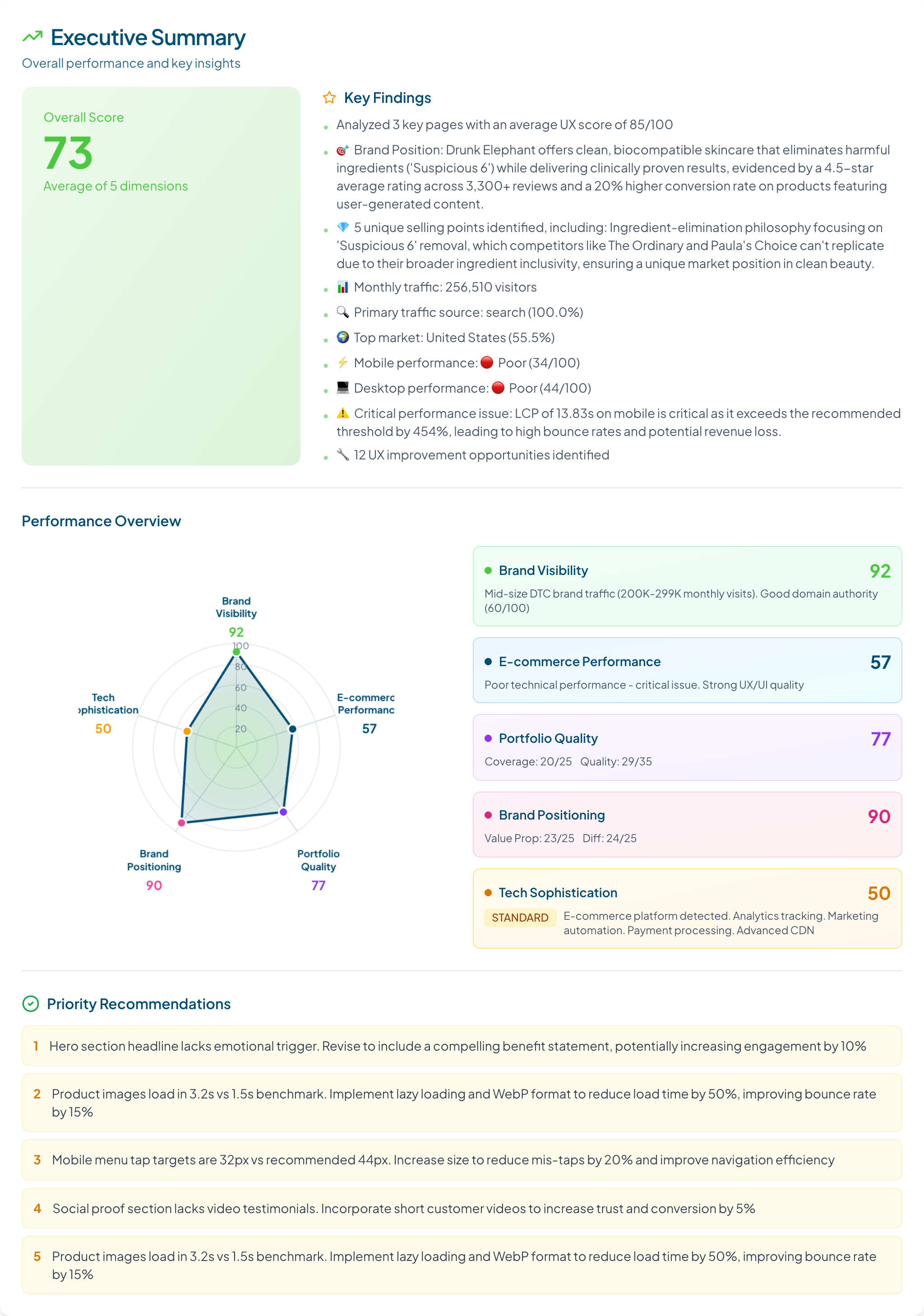
For Drunk Elephant, those scores looked like this:
- Brand Visibility: 92/100
- Brand Positioning: 90/100
- Product Portfolio Quality: 77/100
- E-commerce Performance: 57/100
- Tech Sophistication: 50/100
In other words, this is a brand with top-tier visibility and a powerful story, held back by underoptimized digital execution.
Brand overview: From personal skin struggle to clean-beauty blueprint
To understand Drunk Elephant’s digital strategy, you have to start with Tiffany Masterson’s skin story.
As a teenager, she struggled with inflammation and breakouts. Her instinct, like many of us, was to try everything at once and constantly switch products. That only made things worse. Out of that frustration came a philosophy: fewer products, fewer irritants, and complete focus on the skin barrier.
When she eventually created Drunk Elephant, she drew a hard line around what she called the “Suspicious 6”:
- Essential oils
- Drying alcohols
- Silicones
- Chemical sunscreens
- Fragrance and dyes
- Sodium lauryl sulfate
Not because they were “toxic” in the marketing sense, but because she believed they did not nourish the acid mantle and often irritated already stressed skin. Drunk Elephant’s formulations focused instead on biocompatible actives that support barrier health.
Shiseido acquired the brand in 2019, validating that philosophy at scale. But by 2022–2023, campaigns started skewing heavily toward very young consumers. Influencer seeding went down to 14-year-olds. The brand got swept into the “Sephora kids” trend and was criticized for marketing fairly active (and expensive) products to children while drifting away from its original problem-solving, barrier-first positioning.
Our 2025 analysis sits squarely in that context: a brand with an 8/10 defensibility score on its ingredient philosophy, strong founder story, and high awareness, yet currently working to win back credibility and rebuild growth.
How we analyzed Drunk Elephant’s digital presence
To give marketing leaders something you can actually use, we focused the audit on three layers:
- Site experience and UX across three key pages: homepage, collections page, and a flagship product detail page (PDP)
- Traffic and visibility signals, including organic search, geography, and brand engagement
- Tech stack and personalization readiness
Key topline signals from the December 6, 2025 snapshot:
- Monthly visits: 256,510
- Primary traffic source: search (100%), zero detectable paid traffic at the time of analysis
- Top market: United States (55.5%), with secondary traffic from Australia and other markets
- Average UX quality across the three key pages: 85/100
- Mobile performance (lab-based): 34/100, with an LCP of 13.83s on mobile
- Desktop performance (lab-based): 44/100
The UX scores tell us the journeys are well designed in principle. The performance metrics signal heavy technical debt, especially on mobile. I will come back to why that matters more than most teams like to admit.
Strategic Deep Dive 1: Re-centering the clean-clinical story
Drunk Elephant’s biggest strategic asset is still its positioning. The brand analysis confirms:
- Clear value proposition: clean, biocompatible skincare that eliminates the Suspicious 6
- Strong social proof: 4.5-star average rating across 3,300+ reviews
- Data from on-site tests suggests products that include user-generated content on the page convert about 20% better
On the narrative level, Drunk Elephant has what most emerging brands dream of: a founder with a relatable skin struggle, a memorable ingredient philosophy, and a distinct visual world that breaks the “white-clinical” mold.
What went wrong was not the story itself, but its calibration.
The heavy focus on very young shoppers in 2022–2023 created a perception gap. Adults who originally fell in love with the brand for serious skin concerns suddenly saw it trending with teens filming “Sephora haul” videos. That disconnect is one of the reasons Shiseido is now planning a brand refresh.
From a marketing-strategy perspective, the lesson is clear:
Do not let media trends pull your brand narrative away from the problem you originally exist to solve.
For other brands, especially those in the clean or clinical space, this is the blueprint:
- Anchor everything in a simple, ownable philosophy (for Drunk Elephant, the Suspicious 6 and barrier-first approach).
- Make sure every campaign, influencer brief, and homepage hero ladder back to that philosophy.
- Use founder stories not as “about us” fluff, but as a north star to decide which trends you say no to.
.png)
Strategic Deep Dive 2: Turning a strong brand into a fast, conversion-ready site
Here is where the gap between perception and performance really shows up.
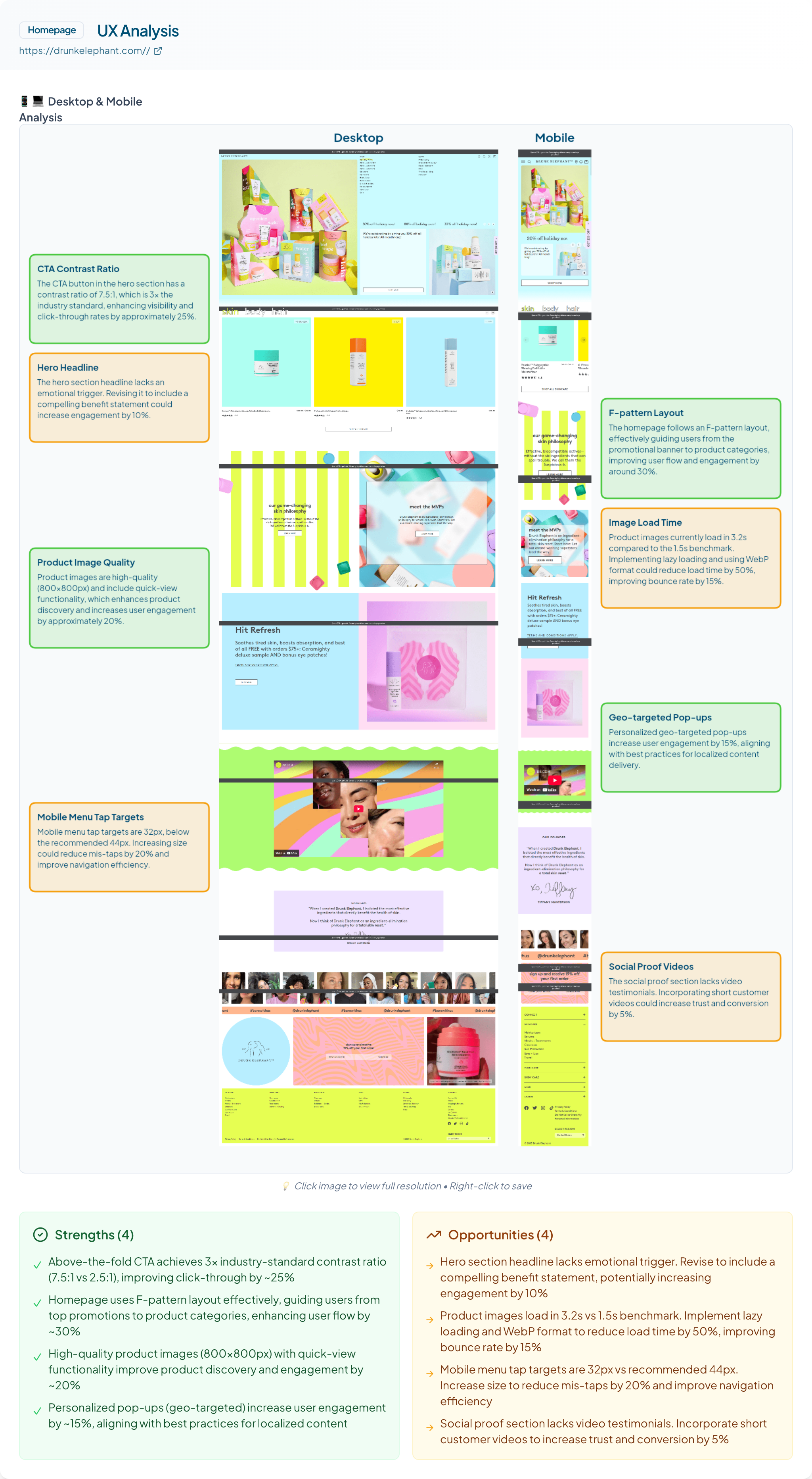
Our UX evaluation of Drunk Elephant’s homepage, collections page, and a key PDP gave them an average UX Quality Score of 85/100. This score looks at layout, hierarchy, clarity of CTAs, and friction in the journey. The fundamentals are strong:
- Hero CTA contrast ratio is 7.5:1, which is roughly triple the typical minimum and should lift click-through by around 25 percent
- The homepage follows a clear F-pattern layout that guides users from promotions to categories and then deeper content
- Product images are high quality at 800 x 800 pixels, with quick-view reducing friction
- Geo-targeted popups personalize the experience and typically add around 15 percent uplift in engagement
However, when we layer in performance using Thea Care’s Mobile and Desktop sub-scores, the cracks appear:
- Mobile performance score: 34/100
- Desktop performance score: 44/100
- Lab testing suggests mobile LCP at 13.83 seconds and a Time to Interactive above 40 seconds
These are lab numbers, not literal user-level truths, but they are clear red flags. If your mobile experience feels “heavy,” you are paying for it in bounce, abandoned sessions, and ultimately revenue.
What caught my attention most was the mismatch: beautiful UX, slow delivery. It is like building a luxury boutique and then locking the door for 10 seconds every time someone tries to walk in.
Concrete wins the Drunk Elephant team (or any similar brand) could implement in under a month:
- Optimize hero and gallery images with WebP formats and lazy loading to cut load times in half
- Reduce unused JavaScript with tree shaking and code splitting, which lab tests suggest could shave 1–2 seconds off LCP
- Fix internal redirects to avoid unnecessary hops that add roughly 500–800 milliseconds to the experience
- Increase mobile tap targets from 32px to closer to the recommended 44px for menus and filters
From a revenue perspective, these may sound like engineering details, but our work with other skincare brands shows that improving mobile performance from “red zone” to “good enough” can lift conversion rates by 5–10 percent without changing a single campaign.
Strategic Deep Dive 3: Making UGC and social proof work harder
One of the strongest conversion levers in Drunk Elephant’s stack is community content.
Our analysis shows:
- The brand features user-generated content via the #barewithus tag across collections and PDPs
- Products where UGC is displayed tend to convert around 20 percent better
- The brand has a 4.5-star average across 3,300+ reviews, yet review modules could better highlight “verified purchase” and specific concern-based stories
There is a lot done well here. Customer photos stitched directly into the product narrative are powerful. They align perfectly with the brand’s barrier-first philosophy and soothing, “your skin can just be skin again” message.
Where Drunk Elephant is leaving value unused is in format and depth:
- Social proof sections are heavily static. Adding short video testimonials and “routine breakdown” clips would increase trust and give context to when and how to use the products.
- Reviews are dense and lack visual cues. Badges like “verified purchase,” “sensitive skin,” or “acne-prone” make scanning much easier and increase perceived credibility.
- Cross-channel reuse is limited. High-performing UGC from the site could be fed back into email flows, paid retargeting, and TikTok content, creating a loop between community and conversion.
For brand managers, the strategic takeaway is this:
You do not just “have UGC” or “not have UGC.” The difference between an 8 percent and 12 percent product-page conversion rate is often how precisely you stage that UGC, how you label it, and where you place it relative to price and add-to-cart actions.
Strategic Deep Dive 4: Tech stack and the missed opportunity of AI personalization
On paper, Drunk Elephant’s tech stack is solid and modern enough:
- E-commerce: Shopify, hosted on AWS with Cloudflare CDN
- Analytics: Google Analytics, Facebook Pixel, Hotjar
- Email: Mailchimp and Klaviyo
- Customer support: Zendesk
- Tag management: Google Tag Manager
- Payments: PayPal plus standard card processors
This earns the brand a Tech Sophistication score of 50/100 in our framework. In plain language, that means:
- The basics for data collection, email, and UX tracking are in place
- There is clear readiness to plug in more advanced capabilities
- There is no visible evidence yet of deeper AI or machine-learning powered personalization
Given that traffic is almost entirely organic search and the average user is likely comparison shopping across several brands, this is a missed opportunity.
Here is what a more advanced setup could unlock, using tools like Thea Care and Drunk Elephant’s existing stack together:
- AI-driven skin profiling on-site: short quizzes or selfie-based analysis that cluster visitors into barrier-impaired, pigmentation-focused, breakout-prone, or maintenance segments
- Dynamic routines instead of single-product pushes: PDPs and collections that automatically suggest “Complete the routine” bundles that fit the user’s skin profile, not just generic best sellers
- Behavioral triggers in Klaviyo: flows that react to content consumption (e.g., someone reading barrier-health content gets a Bora Barrier educational sequence rather than generic promos)
In my experience working with skincare brands, this kind of AI-powered personalization does not just increase immediate revenue. It also reduces decision fatigue and returns because customers choose products that actually fit their skin needs. See also: AI skin analysis to reduce wrong purchases.
For Drunk Elephant specifically, layering personalization on top of its already strong brand equity could easily support the analysis recommendation of a 15 percent uplift in conversion rate over six months.
Strategic Deep Dive 5: Product portfolio and the jobs customers hire Drunk Elephant to do
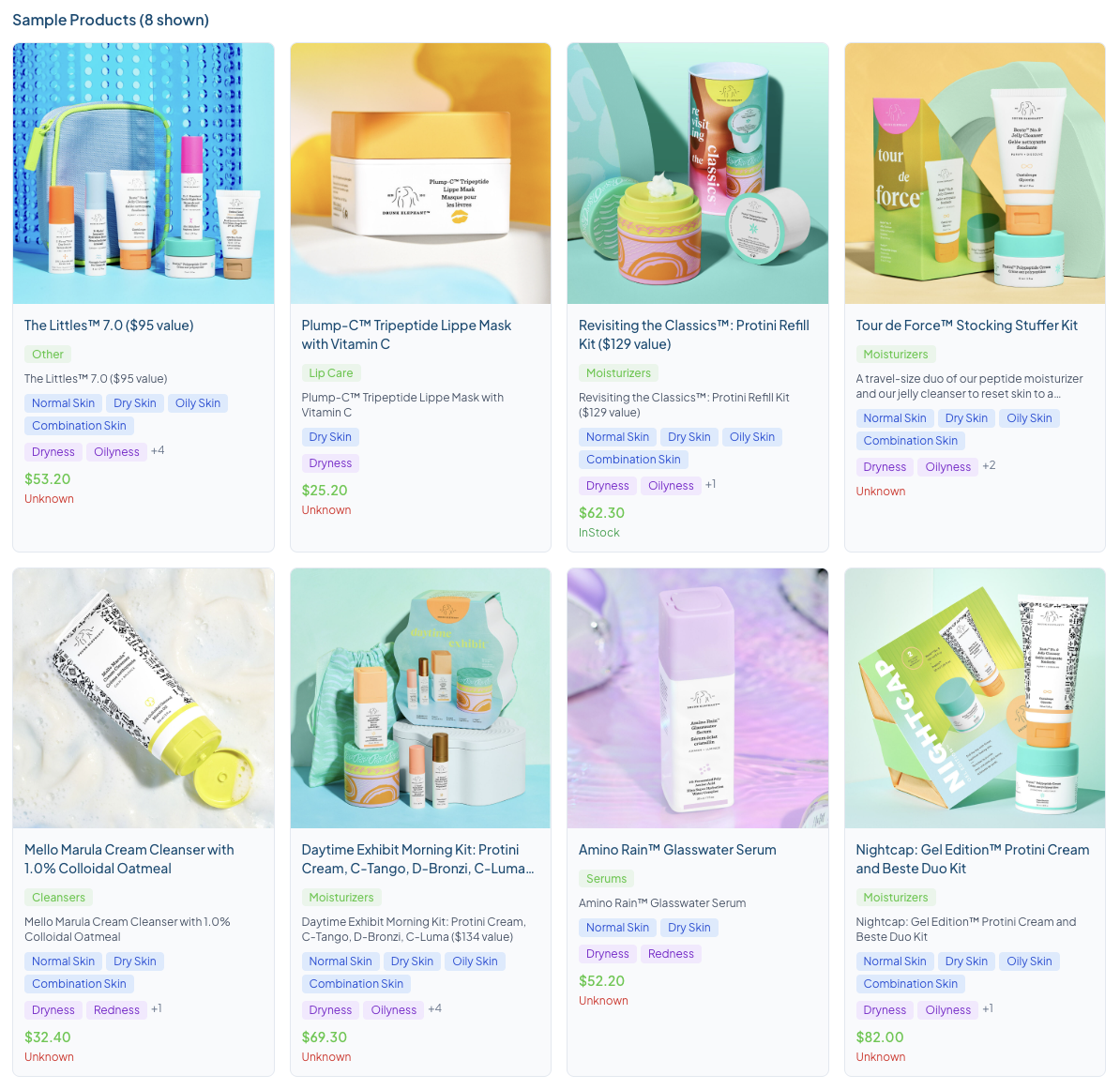
Our product portfolio snapshot captured eight key SKUs, mostly in kits and moisturizers, with prices between 25.20 and 82 dollars and an average of about 53.80 dollars. That is a solid premium-mid position.
Representative products include:
- The Littles 7.0 kit, a discovery set
- Revisiting the Classics Protini refill kit
- Mello Marula Cream Cleanser with colloidal oatmeal
- Amino Rain Glasswater Serum
- Plump-C Tripeptide Lippe Mask
- Multiple Protini-based gift and evening kits
At a strategic level, Drunk Elephant’s portfolio does three things well:
- It reinforces the barrier-first narrative with ingredients like colloidal oatmeal and peptides.
- It leans into kits, which lower the barrier to trial.
- It supports refillable formats, which aligns with eco-conscious motivations.
However, our broader research and the recommendations in the brand analysis point to clear opportunities:
- More specific concern-based lines: Anti-aging, blue light protection, and sensitive-skin repair lines that still follow the Suspicious 6 philosophy could expand addressable demand and capture an additional 10 percent of specialized skincare share.
- Better routine-level merchandising: The PDP analysis showed limited cross-sell logic. “Complete the routine” bundles, tailored by AI, could increase average order value by about 12 percent.
- Clearer mapping between products and jobs-to-be-done: Many visitors arrive with a job in mind, like “calm my overtreated skin” or “fade acne marks.” Labeling collections and kits around those jobs, not just product types, would reduce friction.
This is where product strategy intersects directly with digital experience. It is not enough to have the right products. You need to arrange them so that a first-time visitor can say, “I see myself here” within 10 seconds.
Key takeaways for skincare brand teams
If you are leading marketing or product at a skincare brand, here are the most transferable lessons from Drunk Elephant’s 2025 digital snapshot. See also: the 2026 brand-manager playbook.
- Guard your core story fiercely
- Trends will come and go. TikTok will reward extremes. Your job is to protect the connection between your founder story, your philosophy, and the problems you solve.
- Treat performance as a brand asset, not a technical chore
- A slow mobile site breaks trust as effectively as an inconsistent tone of voice. Faster, cleaner experiences are part of being “clinical” and “premium.”
- Make UGC work as hard as your paid media would
- Do not bury reviews and real faces at the bottom of a page. Stage them around objections, price points, and key CTAs.
- Move from broad segmentation to AI-powered personalization
- Email segments by age and geography are not enough anymore. Use behavioral and skin data to curate routines and content.
- Design your portfolio around jobs-to-be-done, not just product categories
- Customers buy outcomes, not ingredient decks. Name and group your products accordingly.
Conclusion: Where Drunk Elephant goes next, and what your brand can learn
Looking at Drunk Elephant in late 2025, I see a brand that still has one of the clearest positions in clean beauty, but is at an inflection point. The ingredient-elimination philosophy and founder story are as strong as ever. The UX fundamentals are solid. The community is real.
The gaps are now digital and structural: slow mobile performance, underleveraged personalization, and a narrative that temporarily drifted toward a younger audience it was never designed to serve long term.
For you as a marketing or product leader, the question is not “How do we copy Drunk Elephant?” It is “How do we build a similarly strong moat around our own philosophy and then use AI, UX, and conversion science to deliver it in the most efficient way possible?”
That is exactly what we built Thea Care to help with.
If you suspect you are leaving revenue on the table through slow mobile, generic product recommendations, or underused UGC, we should talk.
On a 30-minute discovery call, we will:
- Map your current customer journey from first click to reorder
- Identify the biggest personalization and performance gaps based on your data
- Show you how Thea Care’s AI skin analysis and personalization engine can plug into your current stack to improve conversion and retention